Chapter 3. Toward Axiomatic Morality
Our system of morals should be derived from a complete, self-consistent, mutually independent set of first principles that can be explained to a six-year-old and upon which most educated people can agree. If, in addition, those who dissent – even after we have employed our most compelling logical testimony – can be accommodated without coercion and without inconvenience to themselves or us, we shall have done very well indeed. – Chapter 1, above
Table of Contents
Toward the Elimination of Gray Areas from Morals and Ethics
The Statement of the Freedom Axiom
The Beauty, Reasonableness, and Practicality of the Freedom Axiom
The Corollaries of the Freedom Axiom
Corollary 1 Establishes Freedom To Dissent
Humane Treatment of Violators of Rational Morals that Tolerates Dissidents
Corollary 2 Prevents Inequality of Status
Definition of Status and Its Implications
Corollary 3 Establishes the Moral Necessity To Share Material Wealth
Drawbacks of Inequality of Material Wealth
Definition of Proper and Improper Games
The Money Game as an Improper Game
Corollary 4: What If Everyone Did It?
Corollary 5 Specifically Permits Abortions and Drug Use
Theorem 1 Establishes the Immorality of Material Compensation for Economic Deeds
Theorem 1 Disqualifies Employment as an Institution
The Rights of Members of Social Links
The Rights of Children As Individuals
The Rights of Children As Animals
The Rights of Children As Sovereigns
The Theorem Concerning the Treatment of Children
A Quasi-Steady-State Environment
The Basis for the Environmental Axiom in the Three Criteria
The Necessity To Control Population Growth
The Environmental Axiom as a Corollary of the Freedom Axiom
Exclusion of Unfalsifiable Statements
Mathematical and Logical Truth
Empirical Truth: Verification and Induction
Scientific and Historical Truth
Probability, Macrofacts, and Microfacts
Must Be Said with a British Accent
Truth about Events in Our Own Minds
Truth about Events in Other People’s Minds
Additional Discussion for the Mathematically Inclined
What a Statement Is from the Existential Viewpoint
What a Statement Is from the Functional Viewpoint
Analysis of Statements Using a Model Inspired by Mathematical Categories and Functors
Examples of Failed Communications, Usually Purposely Deceptive
Tarski’s Theory of True Statements
The Statement of the Truth Axiom
Justifying the Truth Axiom According to the Three Criteria
Immediate Corollaries of the Truth Axiom
Answer to the Puzzle about the “Little Town in Iowa”
Appendix: Why Taking Drugs Per Se Imposes on No One
Introduction
Disclaimer
In Chapter 1, I noted that we are far from that advanced state of affairs where legislators would be unnecessary inasmuch as anyone with an inference engine (computer and appropriate computer program) could test automatically whether a given proposition was a “law” (or not) by deriving it (or its contradiction) from fundamental axioms or first principles. Presumably, we could dispense with the inference engine if we could agree upon a basis. I hope to convince the reader that reasonable morals and ethics are simple. At least the simple morals proposed here are reasonable! Perhaps simple morals are more likely to be rendered reasonably. As complexity increases, so does the opportunity for mistakes in logic. The American legal system is complex to the point of madness.
Nevertheless, it is unlikely that I shall be able to derive rigorously, in the space of a few pages or even in a thousand pages, a complete, self-consistent system of morals based on three axioms that can be stated without ambiguity; so, this chapter must be taken to be a very rough sketch indicating only the direction such a derivation might take. Hopefully, though, an open-minded reader might accept the plausibility of such a project and our mutual understandings of the intuitive meanings of some of the basic terms employed here might allow this discussion to serve as a common basis for developing an acceptable political, economic, and social philosophy based upon morals.
As discussed in Chapter 1, I call this philosophy a minimal proper religion (MPR). (I have employed the word religion to accommodate people who insist that all moral judgments are religious in nature. Whether my moral philosophy is a religion or not is unclear.) It is supposed to be the basis of a rational social contract that has a decent chance to be embraced by an entire community (except for a few dissidents), in which case the members of the community are governed by moral consensus rather than by laws. They can live in peace and harmony essentially without government.
[Note in proof (6-26-97). I mean government in the conventional sense. Of course, the entire community may meet from time to time on an ad hoc basis to decide by mutual consent matters that affect everyone, which might involve flipping a coin to resolve disputes and, occasionally, selecting by some random process an ordinary, undistinguished member of the community in whom special responsibilities are to be entrusted temporarily. Under these circumstances, a common body of assumptions is even more essential than it would be in a modern coercive government. Since, quite generally, the governed may not exercise freedom that is in conflict with governmental policies, all modern governments are totalitarian. Perhaps readers who do not agree with this “extreme” view will wish to reconsider later – after further discussion (and, hopefully, a little personal reflection).]
The philosophy described in this chapter and the next should be recognized as something that has a much stronger claim upon the term social contract than anything that has been palmed off on the people previously under that banner. In the United States, what influential people call “our social contract” is certainly not deserving of the name.
Also, although this document attempts to follow the procedures of pure mathematics, it is impossible to prove propositions completely rigorously as one would do in abstract algebra, for example. The most we can hope to do is prove our claims as rigorously as social propositions are ever proved.
Of course, my moral sense did not arise from a set of axioms. I know a priori what the morals to be derived should be. The axioms stated below were abstracted from concrete examples (actually from my personal moral biases, discussed below) using what I have come to know as the inverse method. (These biases are revealed in the next subsection, at least in part for the benefit of both my friends and my critics to make it easier to refute my thesis.)
Note. Religious people might agree that Axiom 1, below, is a practical way of ensuring that people will behave as though they accepted the commandment “Love thy neighbor as thyself,” while Axioms 2 and 3 might be interpreted to exhort, “Love God with all thy heart and soul.” In this context “God” is supposed to encompass Nature and Truth.
Although I have rejected the Christian Science definition of Truth as God, I do regard Truth as something we might worship – where “worship” is taken to be a high degree of respect congruent with appropriate behavior in one’s everyday life. Suppose we behaved as though Truth were watching us and listening to our minds constantly and knew every deed, every pre-verbal thought or inclination whether voluntary or not, everything (as discussed in Chapter 1) in the universe (U), the ideals (I), the relations (R), and mind (M) pertaining to ourselves however remotely connected. Suppose nothing mattered to us except how Truth might judge us now and until the end of time. How would that affect our frivolous and wrong-headed inclinations each of which goes into the record of Truth along with everything else never to be forgotten or erased? Hopefully we would know better than to beg favors from Truth, but we do not beg favors from God either, do we!
Toward the Elimination of Gray Areas from Morals and Ethics
Nowadays, we have a large contingent of scholars, intellectuals, academics, and quacks who are representing themselves as ethicists. Ethics is portrayed as an unending series of deep and complex issues – each one requiring delicate weighing of facts and circumstances with the wisdom of Solomon. The “experts” continually refer to so-called gray areas that no tried-and-true set of precepts can subsume. To unravel these enigmas we require the expertise of specialists with years of experience at medical ethics, environmental ethics, business ethics, and so on. How convenient for educated people with no talent or interests! The “professional” ethicist is trying to build a castle of sand on a thoroughly eroded shoreline of cultural tradition that has been under water for at least ten thousand years and counting.
One cannot base a valid ethical system on tyranny, falsehood, and a complete misunderstanding of man and nature. Religion, as we know it, i.e., improper religion, is the primary culprit. When Moses, for example, went to the children of Israel and announced that he had spoken with God, Himself, and that he was prepared to pass God’s commandments from God to man, he was lying through his teeth; but, as is generally the case among Westerners (at least), he imagined that the end justified the means. He thought that a just cause justified any means whatever.
I believe that it is possible to think deeply about ethical situations and see the bare bones of situations without the complexity. I believe it is possible to assess every ethical situation in terms of three or fewer moral axioms without any gray areas arising.
Imagine what that could do for humanity. It renders laws, legislators, judges, and police obsolete. It makes rational anarchy possible. My PhD thesis advisor, Prof. J. D. Seader informs me that many years ago a man claimed that, if we learned the right morals, we could dispense with government. That man was none other than Joseph Smith. Nor do I imagine that Smith was the first to recognize this simple fact of life, which renders government, which most of us don’t like anyway, unnecessary. Of course, we shouldn’t expect to be satisfied with Joseph Smith’s system of morals.
The task I set before the reader, then, is to assess my ethical system and determine if it is consistent and exhaustive. (I drop the goal of mutual exclusivity (independence) as not worth the trouble to strive for. One can make an extremely compelling case without such niceties.) I would appreciate feedback on this, because no one knows better than I that I could have made a mistake of commission or omission. The challenge is to construct a thought experiment in which a situation arises that is not covered by the moral axioms proposed in this chapter or where so-called gray areas arise. I am waiting.
The Author’s Personal Biases
Why should the readers of this essay care about how my ideas got started? To be honest, I don’t think they should; they should judge my arguments according to the merit of the arguments without regard to who is making them or why. But, some readers might wonder what in the world would make a person think like I do. They might wish to dismiss my arguments as the ravings of the product of a disturbed childhood, thereby employing the well-known ad hominem fallacy. I will not give them my life’s story (just yet); but, to aid my critics, I will reveal my earliest impressions concerning the issues under consideration. These are prejudices and biases I picked up without the benefit of rational thought – really just feelings. This essay is supposed to justify those feelings, but the reader might find it useful to be told how my ideas got started. Many writers do not acknowledge that they are writing to promote beliefs that they had acquired without the bother of rigorous thought. The thinking was done much later if it was done at all. This is normal; nevertheless, I believe I give the reader who wishes to refute my conclusions an advantage if I reveal what my beliefs were before I began to think about them. I wish to be refuted if I am wrong, which leads to my first bias.
The Importance of Being Right
Some people think it’s unimportant whether they are right or wrong in their personal beliefs if those beliefs don’t affect directly their ability to satisfy tissue deficits or ensure the safety of themselves and those they care about, which may be very few. To me, being right is not just important, it’s the most important thing in life. Hence this book. (I’m tempted to say being right is the meaning of life; but that would be inconsistent with hard agnosticism; so, I won’t be falling into that trap.)
Nevertheless, writing this book has enabled me to clarify what I believe and has resulted in dozens of changes in my philosophy. Whereas some people think that “whoever has the most toys at the end wins”, I think that whoever has the best philosophy “wins” – if, indeed, life is a sport – as an ubiquitous television commercial in May (the month of the National Basketball Association playoffs) of 1995 would have it. (Television commercials have been telling lies about their products for years; now they have the temerity to spout bad philosophy. How about this one: “You don’t have a right to be thirsty because you have a right not to be thirsty.” [quoted loosely from Gatorade commercial] Wow!)
This need to be right might be irrational. It probably doesn’t matter to anyone but me whether I am right or wrong; and, on my deathbed, it might not even matter to me! My critics will say that I’m merely a conceited, self-important individual full of foolish pride.
Inequality of Wealth
I have never understood why people persist in wanting to enjoy greater wealth than others. Even as a small child I was often ashamed of having more than some of my classmates. I can understand how, in a moment of weakness, we can feel unjustifiably proud of having more wealth than others or even of having parents that do. It’s happened to me. But I still feel that it requires a defective mind to be able to sustain that attitude.
We do not approve of race, color, or gender, which are accidents of birth, as a basis for greater wealth. Why should we approve of intelligence, talent, will power, tenacity, ability to withstand tedium, industriousness, or even “superior” character, which are also accidents of birth, as justification for greater wealth? (We suppose character depends upon heredity and environment. The environment into which one is born surely is the same accident as the accident that selected one’s parents – for all we know.)
Why should an intelligent person who is highly gifted insist on receiving even more gifts as a reward for having received the priceless gift of intelligence? That’s just the way I feel. But, when, in addition to the ugliness of vast differences of wealth, I perceive highly undesirable social consequences, I am inclined to believe that differences in wealth must be immoral.
Bosses
I have never liked the idea of having a boss. I can safely say that I have never had a boss whose authority seemed valid to me. (I’m sorry, Henry, Howard, Alan, and Charlie. I love you all, but that’s how I feel.) I don’t know whether anyone deserves to be my boss or not, but I can’t believe that anyone else knows. If a worker needs advice or direction, he should select an advisor. It shouldn’t be necessary to beg for the type of assistance that good bosses sometimes give; I believe the old adage “beggars can’t be choosers” does not apply. Presumably, people other than the worker have an interest to see the work carried out. We ought to be accustomed to giving a little time to helping colleagues. Our peers will tell us when we are screwing up.
All through school, we are judged (basically) on how we perform on canonical tests. (It is true that what our teachers think of us influences our success slightly; but, in the face of written test scores, it is hard for teachers to discriminate blatantly.) When we leave school, however, our success depends on what someone else thinks of us. I can’t accept that. When I was an assistant professor, I announced that I would not submit to peer review for tenure. Isn’t it bad enough that someone can decide whether or not our papers are published and whether or not our proposals are funded!
I don’t like the institution of boss, manager, or leader – whatever it’s called. It irritates me that George Bush has more political power than I do.
Influence
Lately, I have attended a number of meetings – political, technical, philosophical – at which I have not been invited to speak. That bothers me. Why should someone else be asked to speak and not me? Are not my ideas as good as theirs? Who would know? Who reads the essays of an unknown? One has to “work oneself up” to a position of influence. That can’t be right. In many cases, by the time the thinker has worked himself up to a position of influence, he has succumbed to the routine of his life and his ideas have become pedestrian and anemic. Sometimes, the ideas of a person of influence have survived his ride up the prestige ladder; but, he has too much to lose to insist upon them in public discourse. For example, in the case of Noam Chomsky, he has brilliant ideas; but, because he has a highly valued position to lose (full professor at MIT), he must confine his remarks to criticism of the status quo, and may not tell his audiences what he would choose as an alternative economic system – except I believe I heard him mention in passing (only) anarcho-syndicalism, which I take to be a reference to his own political position. I have not read his books, which I recommend to the reader to corroborate my own ideas (but which I imagine I don’t need to read myself, as I am already a believer); so, I may be doing Professor Chomsky a disservice. If so, I apologize. [Note in proof (9-27-96). Lately, I have read three books by Herman and Chomsky [1] and Chomsky [2,3].] My point is that ideas should be judged on their own merits – not according to who holds them. Thus, the system of discourse is badly flawed. I resent that and intend to do whatever I can to fix it. If I should ever become a person of influence, I hope I remember what I am saying now. Unfortunately, I would most probably become like everyone else of influence, namely, a complete idiot. I’m sorry, but that’s my prejudiced point of view.
Business and Jobs
I have never liked business and commerce. My father was a businessman. His work seemed boring and inconsequential. I resent the business parasites who drive around in German cars with telephones. (I don’t need the driver next to me getting a margin call in rush-hour traffic.) Businesspeople make life difficult for me because they cause money to have more importance than it deserves.
Don’t tell me business creates jobs. Let us consider the principal factors in a person’s engagement in an economic enterprise: (i) the impact upon the environment, which might be quantified in terms of emergy consumed; (ii) the usefulness (to living creatures) of the items produced; (iii) the effort put forth and the time expended by the participant; and (iv) the reward received by the participant. The first two items represent precisely what is crucial in sound economic thinking; the last two items have virtually zero impact upon the preservation of species, whereas they are the first things that people consider when they think of economic enterprises as jobs! This illustrates the essential impracticality of the institution of employment as we know it.
Business doesn’t create anything; it only consumes. Therefore, the concept of job must be flawed. Imagine. Selling the time of one’s life! Where is the merit in creating jobs – an activity about which exploiters of the labor of others like to boast! The most prominent effects of jobs on society are undesirable. A job prevents someone from contributing to the common good without being exploited. Jobs poison intrinsic motivation. They destroy opportunity rather than create it. Personally, I hate jobs!
The Freedom Axiom
Personal Sovereignty
Definition (Rights). Rights are (i) freedoms that don’t violate accepted morals and (ii) entitlements that are guaranteed by accepted morals.
The personal sovereignty of adults is assumed and is not in question. In the absence of better information, we must assume that every new arrival to this universe is the lord and sovereign of his or her own being, and our earliest memories seem to indicate that the new arrival shares that view. One’s sovereignty over one’s own being is a right. Determining who enjoys personal sovereignty is an important part of the Freedom Axiom. We mention personal sovereignty here to motivate the next section, The Purpose of a Human Life, which could have been derived rather than assumed; but the derivation would have rested directly upon the Freedom Axiom, which itself is assumed but is shown to pass the tests of aesthetics, reasonableness, and utility.
[Note (12-9-04). With respect to the debate over abortion, which has subsumed genuine political issues in electoral politics, the moral issue is not the beginning of human life but rather the beginning of human rights. Clearly, human rights begin with the severing of the biological connection to the mother and not before.]
One wonders whether personal sovereignty extends to animals and even, perhaps, to plants. I refuse to discuss the sovereignty of plants here, mainly because I do not wish to appear crazier than I am, except to say that the idea is not absolutely out of the question. The question of the sovereignty of animals remains open. Personally, I regard animals as belonging to themselves, but I recognize that this would be a difficult point to sell to a cattle rancher. I rarely ask the permission of pet owners to address their pets, as I regard dogs, cats, and horses as people. Perhaps this is going too far. I do not insist upon it. After all, it is very difficult to protect rights that cannot be exercised.
Newborn babies, though, are entirely helpless and dependent on other people for survival and, therefore, are unable to protect their sovereignty. Does that mean that their sovereignty is invalid? If that were so, one could infer that the sovereignty of the weak is always at the mercy of the strong, but that would violate our derived sense of morals, as we shall make more definite in the sequel. In the system of morals described here, we protect animals (other than human beings) under an environmental axiom without insisting upon their personal sovereignty, but we establish the personal sovereignty of human beings under the Freedom Axiom. In particular, we insist upon the personal sovereignty of children and adults in order to determine how they are to be treated when they are in conflict with the rest of society and all other moral options have been exhausted. (This is not quite the case for very young infants incapable of reason. Their personal sovereignty is held in custody by their parent(s) or guardian(s) and they are protected from their parents and guardians by the moral axiom that prohibits cruelty to animals. This makes more sense when the details are discussed below.)
The Declaration of Independence states that the right to liberty, which is intimately connected to personal sovereignty, is unalienable. (The modern spelling in inalienable.) This legal term means the right cannot be transferred to another person nor can it be repudiated. The Ninth Amendment indirectly incorporates this right into the Constitution; so, under the Constitution, we are free whether we want to be or not! However, I do not believe this inalienability extends to small children and I don’t believe that the Founding Fathers intended it to. I assume that newborn children temporarily transfer their personal sovereignty to their parents or guardians automatically and, presumably, voluntarily with the first whimper for succor. Older children may transfer personal sovereignty deliberately. The asymmetry between adults and children typically creates moral complexities. I believe we have unraveled these complexities in this chapter and the next two chapters.
Although the Founding Fathers are stuck with what they wrote, the Supreme Court notwithstanding, I am not. Even though I do not accept the Constitution in any permanent sense, I am entitled to use it to point out the inconsistencies of people who do believe in the Constitution but violate it routinely. Perhaps, the political philosophy expounded here requires a new constitution – without elected officials, for example. On the other hand, perhaps no document whatever would serve us best.
Definition (Personal sovereignty). Personal sovereignty is complete control over one’s own mind and one’s own body and its interior, defined so as to include the digestive tract, the interior of the head, etc., in analogy with the supreme and absolute power of a king or queen over his or her domain. Personal sovereignty permits the individual who possesses it to enter into treaties and contracts with individuals, with society, and with social institutions or to refuse to do so and to continue to be treated with respect.
The Purpose of a Human Life
It is assumed in this essay that a human being is the sovereign of his (or her) own being, not a beast of burden the purpose of which is to serve another, presumably superior, human. Whereas a human being may wish to serve others as a manifestation of his (or her) nobility or “to serve God” or some higher purpose in order to transcend himself – from the viewpoint of worldly affairs, he is basically his own person, an end in himself, not a means to an end. Man has been searching for the meaning of life for a long time and many people believe they have found it, but no one can present incontrovertible evidence that would be acceptable within the philosophy discussed here to permit these findings to be applied to public affairs. Perhaps man does serve some higher purpose, and I believe that he does, even if that higher purpose be no more than his own personal conception of the transcendent; nevertheless, no one may assume that a higher purpose exists and, more important, no one may attempt to impose his conception of the function of man upon other people or upon society. The purpose of man and the meaning of life are private matters.
[Note. I had something very definite in mind when I wrote “personal conception of the transcendent”. Clearly, the sum total of a person’s thoughts, words, and deeds exists as a spiritual entity since it can be conceived of, stated in words, and communicated to another person – in principle. This is something that exists. If we could step outside of space-time into whatever space-time is embedded in, if such a thing exists, this entity might be observed as an object, a string of events. This object whether spiritual or material can have meaning. The meaning is transcendent and might be taken by a human being to be the purpose of his life. Clearly, we are free to assign meaning to life in any way we choose or not at all.]
But, people who wish to give a person a purpose other than himself are typically interested in his function as a part of an economy, or as the defender of a nation, or in some other capacity that is not in his best interests. It is this function that is rejected here. This is a humanistic philosophy. We hope to put an end to the exploitation of people as a means to an end. Further, we hope to show that this exploitation is not only immoral but a recipe for doom in keeping with our other demonstrations that from evil comes nothing but more evil – certainly nothing sufficiently good to overbalance the evil. (I am assuming that the “litmus test” of Matthew 7:17,18 can be applied to any institution – not just prophecy. “[B]y their fruits ye shall know them.”)
The Statement of the Freedom Axiom
Definition (Freedom). Freedom is the exemption from external control, interference, regulation, etc. It is the power of determining one’s own actions or making one’s own decisions. These are dictionary definitions; but, for political purposes, there must be a temporal component to the definition. The exemption from external control, for instance, must be in perpetuity. Political freedom must include freedom from fear that the freedom can ever be abridged.
[Note in proof (1-12-98). Perhaps the word autonomy would have been a better choice for this essay. Clearly autonomy is a necessary condition for freedom. The dictionary assigns many more meanings to the word freedom than it does to the word autonomy even though the two words are synonymous! I feel the word freedom is somewhat more compelling, though; and I am willing to take the trouble to disqualify freedoms that impose upon the freedom or autonomy of others. The definition of happiness adopted from Deci and Ryan [5] employs the term autonomy (as a condition for happiness).]
Note. As discussed by Deci and Ryan [5], freedom involves internal conditions as well as external conditions. Normally, people who are involved in the competition for wealth and power are acting under psychological conditions that preclude freedom. In the language of Deci and Ryan they are extrinsically motivated. We are sorry that rich and powerful people are not truly free, despite the relative freedom that comes from their large compass of movement, but we are sorrier still that they prevent us from being as free as we should be, regardless of our internal psychological state. The truth may make us free to some extent, but it cannot grant us access to the beach at Malibu except by an unacceptably circuitous route. We may not be held by fetters of our own making, but we cannot view the most beautiful portion of Paradise River unless we are members of the Plutocrat Hills Golf Club.
Definition (Adult human being). An adult human being is a mentally self-sufficient (human, not animal) person. (At this point I don’t want to cut it any closer than that.)
Definition (Child). A child is the offspring of a human being still dependent on and, normally, living in the abode of natural or surrogate parents.
Note. We have omitted the case of (human) people who are neither children nor adults.
Definition (Human social link). A human social link is an adult human being and any dependent children.
Axiom 1 (The Freedom Axiom). The adult members of human social links are free to do anything they please provided they do not impose (in the present or in the future) upon the freedom of other human social links. (Nearly everyone agrees that his (or her) freedom ends at my “nose”, however many people disagree as to what “impose” means.) Further, the adult members of human social links possess personal sovereignty, which is nontransferable (inalienable), except when they permit their personal sovereignty to be placed in the custodianship of others under the exceptional circumstance that they have violated morals or rights to which they subscribe. Adult members of human social links are the custodians (or co-custodians) of the personal sovereignty of children in their social links until the children reach the age of reason. They may transfer the custodianship of that personal sovereignty to other adults from time to time provided the rights of the child be not abused. After children reach the age of reason, they may elect to leave one or more of their human social links and reclaim their personal sovereignty or to remain in one or more of their human social links and to transfer voluntarily their personal sovereignty to the relevant adult(s) who continue(s) to hold it in custodianship or stewardship. Up until the time the child reaches the age of reason it belongs to the same moral category as animals and is protected by Axiom 2, below.
Definition (imposing upon the freedom of another human social link). If an action interferes with the freedom of another social link but it would not if the members of that link adjusted their mental outlooks appropriately without any other adjustment being made, no violation of Axiom 1 has occurred; i.e., this does not count as imposing upon the freedom of another human social link. If their mental outlook is irrelevant, it counts as imposing upon the freedom of another social link. The point is that we wish to disallow imaginary offenses. For instance, if I can’t go to the Plutocrat Hills Country Club, I can adjust my mental outlook to disparage such a trip, but the fact remains that I must adjust my travel plans as well as my mental outlook. On the other hand, a man’s homosexuality may distress his own mother, but that is because of her attitude toward homosexuality. It does not impose upon her freedom.
Comment. The previous definition explains why this code of morals forbids trade and unlimited reproductive rights, but does not forbid taking drugs and having whatever forms of sex one pleases (so long as an axiom be not violated). An extremely compelling reason for accepting my interpretation of the Freedom Axiom as opposed to the interpretation of the Libertarian Party, say, is that my interpretation eliminates all, or, at worst, nearly all, of the problems that plague society, whereas the interpretation that tolerates commerce, for example, exacerbates social problems. It is no use saying that, if we cannot engage in business, we are not free, because, if anyone engages in business, no one is free. This will be proved by explicit examples in the sequel, even though the a priori reasoning given below is conclusive. (“It is impossible to provide an excessive number of proofs of a proposition that no one believes.”) Clearly, this is a crucial point in my thesis. I must convince the reader that doing business imposes upon the freedom of those who cannot or will not do business – particularly those who do not wish to do business. I will go further and show that it diminishes the freedom of the businessman himself. In Appendix III at the end of the book, I will discuss further why business is immoral but taking drugs is not. I shall attempt to overcome all reasonable objections to my viewpoint.
Rather than provide a philosophical basis for the Freedom Axiom, in the following section I shall defend the notion of equality of personal material wealth, power (including negotiable influence), and negotiable fame. This will turn out to be equivalent to such aspects of the Freedom Axiom as are not readily accepted by nearly everyone, namely, the prohibition of impositions upon ourselves by others and upon others by ourselves, concerning which the conventional wisdom, indeed our entire culture, is curiously silent.
The Beauty, Reasonableness, and Practicality of the Freedom Axiom
Aesthetics
In Chapter 1 we agreed that morals should be based upon aesthetics, reasonableness, and utility. Let us indicate in part how these values can be used to justify Axiom 1. (It is important to attempt to justify the moral axioms by the most convincing arguments we can construct since the fate of the political system proposed in this essay might depend on the acceptance or rejection of the moral axioms.) Clearly, we shall have established the Freedom Axiom if we can make a good case for equality; all the rest is obvious.
Many thinkers and writers, particularly American thinkers and writers, have espoused the equality of all “men”, and yet many of our institutions ensure that such “equality” as we do enjoy shall be meaningless. Presumably equality appeals to us on aesthetic grounds, but we do not construct our institutions always with aesthetics in mind. Axiom 1 espouses ultimate symmetry between adult men and women, while, unfortunately, retaining some unavoidable asymmetry between children and adults. Our love of symmetry is an essential component of our sense of beauty. Even when we avoid it, as when an object in a photograph is placed off-center, the variation calls attention to the underlying symmetry that is intentionally avoided! We build cars with bilateral symmetry just as we ourselves are built, although the symmetry is never exact. In mathematics, symmetry is the underlying concept at the heart of abstract group theory which is at the heart of abstract mathematics. Mathematicians love symmetry for its beauty.
Reasonableness
But, equality among human beings appeals to our sense of what is reasonable. No matter how talented, intelligent, or gifted a person may be, he (or she) ought to recognize that he is no better than other people. Normally our instinct warns us that people who think they are better or more deserving than others lack genuine respect for themselves, which might be evidence of something often referred to as the “inferiority complex”, whether such a thing exists or not. Indeed, equality is more appealing to us than is disparity on the grounds of both aesthetics and reasonableness. Furthermore, those of us who understand the fundamentals of mathematics know that the relations “less than” and “greater than” cannot be applied to a class of objects unless they possess certain properties that humans do not possess. (The problem with applying the relations “greater than” or “less than” to human beings is not that they possess too few attributes but rather too many.) Thus, we cannot establish a reasonable basis according to which one person deserves more freedom, wealth, power, or, really, anything else of value than another. In absence of any such basis, the only relation that makes sense is equality. As Shaw points out, no one person can point to the share of the national dividend that was produced by himself. Moreover, no one can assess the potential contribution of a person who is given his fair share of the national dividend until that person’s life is over – and perhaps not even then.
Utility
But, Axiom 1 can be justified based on its utility and the impracticality of any other moral judgment. The proof of this is the thrust of much of this book. We wish to show that inequality among people is the cause of crime, war, and most other forms of social disorder. Most of us recognize that this is so, but we cannot see our way clear to embracing the idea wholeheartedly. This is mainly because we do not believe in the essential goodness of mankind or even the essential goodness of the universe in which we live. This is shocking and certainly worth serious consideration. Since I shall be devoting many pages to reasons why it is impractical to permit disparities in freedom, power, wealth, and even fame between individuals, I will not attempt to present much of an argument here except to note the following: The time is rapidly approaching when one dissatisfied person who feels he or she has been treated unjustly by society can wreak havoc upon society, perhaps even discharge a nuclear device. The rise in terrorism is a certain sign of this. Soon, people who impose upon the freedom of other people by virtue of greater wealth and power will no longer be safe in their own beds. Inequality will become very impractical indeed.
The Corollaries of the Freedom Axiom
Corollary 1 Establishes Freedom To Dissent
Corollary 1. No one shall force or attempt to force another person to embrace or to be bound by any morals whatever including these morals. Nor shall there be a penalty – direct or indirect, harsh or subtle – attached to the rejection of any moral system. Clearly, I do not share Mr. Shaw’s readiness to label people “eccentric” even, let alone “lunatic”.
Proof. Corollary 1 follows immediately from Axiom 1.
Definition of Justice
Definition (Justice). Justice is the state of human society wherein one of two conditions prevails: (i) all relevant moral requirements have been met or (ii) in case there has been a breach of morals the following events have occurred: (a) the damage due to the breach of morals has been repaired and restitution has been made to the victim(s) and (b) the violator has been dealt with in an appropriate manner, which might not involve punishment or revenge.
Humane Treatment of Violators of Rational Morals that Tolerates Dissidents
Compensation of the victims of injustice is insufficient and, in some cases, impossible. We shall be concerned here with the treatment of violators of valid morals and we must decide what is appropriate treatment for violators. The cases of adults and children must be handled separately. We will discuss the case of children who violate laws based on morals after the axioms and their corollaries have been stated. Further, two subcases must be considered under each main case: (1) the case when the violator accepts the code of morals and (2) the case when the violator does not. Let us consider the normal case first, where the violator is an adult who accepts the code of morals and, in fact, expects to be protected by it.
For those who accept the prevailing
morality, but are
given to transgressions of it, a humane form of rehabilitation can be
found
that does not compound the felony with cruelty or any further suffering
by
anyone. I hope the reader
understands that I am uncomfortable with a discussion that raises the
specter of punishment. Presumably,
the culprit’s acceptance of the social contract permits us to
dispense with
punishment and to give the remorseful transgressor a chance to suggest
the
steps that will help him fulfill his sincere desire not to repeat his
mistake.
Clearly, I am reluctant to punish those who act out of fear of greater
poverty
than anyone can reasonably be expected to bear. This
circumstance would not
arise in hypothetical world  , discussed in
Chapter 1.
, discussed in
Chapter 1.
On the other hand, I have suggested (in an earlier essay) that so-called white-collar criminals be reduced to the lowest economic stratum in society, i.e., minimum wage, which has the interesting property that the punishment becomes (nearly) meaningless at the same time as the crime becomes (nearly) pointless, namely, when material wealth is divided equally, that is, when the minimum wage is the maximum wage – or, better yet, the concept of wages has been abandoned. The reader should understand that I am not recommending jail for such criminals. (Ivan Boesky is in jail at this writing, but he is still a very wealthy man. This is stupid and unfair.) I tend to be much less tolerant of crimes that appear to be motivated by greed, but I suspect lately that these earlier sentiments reveal petty vindictiveness on my part of which I ought to be ashamed. Still, it’s not a bad suggestion.
Some crimes, such as murder, will probably require isolation of the criminal from the rest of society. But, can capital punishment be justified even in cases of murder? Apparently, capital punishment is inconsistent with the definition of justice and the suggestion that murderers be isolated from the rest of society. If society revenges murder with murder, the possibility arises that a mistake be made in which an innocent person is executed for a crime he or she did not commit. This would be a violation of morals for which no reparations could be made and it would require the violator to be isolated from society. But, when capital punishment is employed unjustly, all of society is the violator. Since society cannot be isolated from itself, we have run into a contradiction that could have come only from the assumption that capital punishment is valid. (Obviously, all of society cannot be executed!)
This is the type of argument, referred to in the preface, that is conclusive but unsatisfying because of the disparity in scale between the reasoning and the conclusions. Other reasons for objecting to capital punishment are given in the essay “On Crime and Punishment” in Vol. II of my collected papers [6].
[Note in proof (5-17-97). The Houston Chronicle of May 14, 1997, reported the first instance in Harris County of the acquittal of a person accused of a capital offense. Probability dictates that many innocent people have been put to death. What are the odds that only the guilty are accused? Is it reasonable to suppose that the police will have carried out an investigation sufficiently thorough to satisfy every conscientious juryman? Is it not possible that our self-righteous, Bible-thumping, free-wheeling, gun-toting wild men of Texas prefer an execution to an acquittal?]
It might be objected that no reparations can be made to the victim of a capital crime. Regrettably, this is true; but, the killer was not in the business of dispensing justice, a role the State has reserved for itself along with the associated responsibility, which it does not seem to take seriously, at least not here in Harris County in the State of Texas. (I hope the reader does not disqualify me from this discussion because of the guilt I bear as a citizen of this unhappy place.)
While it is claimed that most individuals who accept the moral basis of society presented in this work can teach themselves to live within its bounds, a society of individuals all of whom belong to the same economic class would be able to afford to put up with a residue of totally worthless incorrigibles. A society from which institutionalized evil has been eliminated would not be plagued by continuous class warfare and a class of individuals who will do anything to acquire greater material wealth. Very few people would want to violate a just system of law. Most of the crime we see in 1990 derives from inequalities of wealth and the unacceptable circumstance of having two sets of laws, one for the poor and one for the rich. Why should anyone submit to this type of institutionalized injustice! Criminals and active dissenters are the only people with integrity under these conditions.
But, as I said elsewhere, intolerable breaches of morals must be treated as acts of war rather than crimes unless the perpetrator embraces the morals in question voluntarily. If a transgressor does not accept the moral basis of our social institutions, he or she must be treated as a prisoner of war rather than as a criminal, and as such is entitled to all of the rights and privileges of a prisoner of war, basically in accordance with the way officers would be treated under a liberalized Geneva Conference, i.e., they may not be forced to work, etc. To make certain that the rights of dissidents are respected no matter how bizarre their deviation from the norm, people who do not accept the prevailing morality must be permitted to live as well as, or better than, anyone. Extreme cases, in which isolation from normal society is essential, present special difficulties.
Islands in the oceans might provide suitable isolation from societies that are unacceptable to heteroclite individuals, provided their chances of survival without the aid and comfort of their fellow man, or all but those who share similar views, are as good there as anywhere else. To protect our own innocence and to avoid errors of the opposite type, we should provide such criminals with palatial residences, abnormally abundant material wealth, and, perhaps for our own selfish reasons, plenty of servants.
These “servants”, or, really, guards, have accepted the community social contract and are expected to behave accordingly. We can rely on them to keep us absolutely safe from extreme deviants, while, at the same time, absolutely prevent such people from suffering merely because they are different from us. Apparently, every society has expected “them” to suffer for not being “us”. This is an exceptionally cruel and unreasonable, but morally cheap, purchase of (worthless) self-righteousness for the majority culture. No one ever achieved virtue, let alone nobility, by punishing others. And doing it in the name of God won’t help. Man needs to emerge from the dark ages. It’s time to reject our atavistic natures – to be, at least, human, if not divine.
Thus, society must treat dissident criminals better than anyone else. In particular, we must provide them with their legitimate needs – really, whatever they wish. What was said above about captive heads of state goes. The person with his own moral code is the moral equivalent of a Napoleon. This is required by the necessity to respect the personal sovereignty of the individual according to the Freedom Axiom. In a natural economy this will not amount to a serious drain on our scarce resources because dissident criminals will be extremely rare – if any exist.
Corollary 2 Prevents Inequality of Status
Corollary 2. It is violation of the Freedom Axiom and therefore immoral for a person to attempt to gain ascendancy or to accept a position of ascendancy over another person other than his or her own child or the children of others who voluntarily transfer ascendancy over their children, thus political power must be shared equally by all adults.
Definition of Status and Its Implications
Discussion: Let us interpret power (we should say “metapower”) as the ascendancy of one person over another. Now, we have discussed how power can be converted to fame or money; fame can be converted to money or power; and money can be converted into power or fame. The reader can verify this for himself by choosing examples from among the powerful, rich, and famous. Wealth, power (including negotiable influence), and negotiable fame are occurrence equivalent. By means of this equivalence, we have shown that whatever is true of power is also true of money and fame (within the social context under consideration).
Excess power abridges the freedom of someone, although perhaps not everyone, who does not enjoy that margin of power, otherwise it would not be power. Therefore, since excess power is prohibited by the Freedom Axiom, so are excess money and excess fame. One may object that this argument depends on the exact equivalence of fame, money, and power; therefore, we should consider the use of direct arguments for eschewing power, money, and fame, although it is fame, probably, that will be the last to disappear from our culture. The harmful effects of our preferred treatment of those who enjoy fame, our so-called celebrities, are easy to discern. Fame, money, and power in any combination contribute to what we call status, rank, or, foolishly, “success”. There is no point in talking about self-esteem for the masses while some people are very much more important than others. Normally, we are not dealing with people of extraordinary spiritual depth who are virtually immune to the influence of social ambiance – what happens on TV, for example. The average American knows he is a person of no importance, essentially a “nobody”; and, if he forgets it, society is certain to remind him in a thousand ways.
Proof of Corollary 2
Proof of Corollary 2. To be in a position of ascendancy over a person constitutes an abridgment of that person’s freedom inasmuch as social transactions cannot be negotiated without coercion or, what amounts to the same thing, the possibility of coercion. This is a generalization of the free-market rule, which requires that all participants in free markets have equal power. (My use of the free-market rule in this context is not inconsistent with my rejection of free-market economies. The free-market rule is the justification for free markets. Paradoxically, it never holds true in actual market systems. This observation shows that there is an inherent inconsistency in the reasoning of free-market proponents.) Clearly, a person with greater political power than another could use that excess power to abridge the freedom of the other in many ways, or it might be feared that he could do so, which amounts to the same thing.
Management and Leadership
The institutions of leadership and management are the tools by means of which the domination of some people by others is legitimized in Western society. If we could not invalidate these institutions, we would be forced to abandon our thesis. We can distinguish at least four functions of leadership or management: (i) the planning of enterprises, (ii) communication between members of the same enterprise and between different enterprises, (iii) the determination of what will be done by each of the participants, and (iv) the creation of distinctions among individuals (as in a caste system). These four functions can be separated. The first function poses no threat of domination of one person by another. The selection of communicators could be accomplished by consensus or by some random or quasi-random process, but the removal of communicators could be accomplished by popular vote. Communicators could serve for fixed terms of from one to eight years, say, after which they could return to their careers. But no leader or manager may exercise power over another adult human being. The function of gifted individuals is to advise not control. The power over enterprises of production could be shared by the producers within that enterprise. Any educated person might be eligible to be chosen by a random process for temporary roles as communicators and almost everyone would be educated. The few exceptions might be termed formally uneducable. The fourth function is an outrage against humanity and any rational hypothetical deity one can name.
Formally Uneducable
Definition (Formally uneducable). By formally uneducable is meant the mentally handicapped, the incorrigible, and others the education of whom must be attended by unreasonable hardship, all of whom are to be distinguished scientifically. (This is a very dangerous point and great care must be taken to avoid abuses.) Of course, mentally incapacitated people are not mentally self-sufficient, so they are not properly classified as adults according to our definition.
Corollary 3 Establishes the Moral Necessity To Share Material Wealth
Corollary 3. It is immoral not to share wealth (both property and income measured in emergy units) approximately equally among adult human beings. Small differences in the wealth that surrounds us in our homes to account for special needs are not important. I don’t care if you have a microscope and I don’t. The vast accumulations of paper wealth and the correlative control of capital is the evil we wish to prevent. Of course, vast inequities in personal consumption are to be discouraged too.
Drawbacks of Inequality of Material Wealth
If one person controls greater wealth than another person, he (or she) perforce enjoys greater political power since he is in a position to trade some of his excess wealth for favors or someone might presume that he is able to so do. Thus, the freedom of the poorer man to choose his own political destiny is abridged without any other event taking place. Wealth is power and power can be transformed into freedom; thus, freedom is relative and the man with relatively greater freedom enjoys this margin of freedom at the expense of the freedom of the man with less freedom. Conceivably, this relative freedom is illusory and both the rich man and the poor man lose freedom.
Excess wealth might be a trap that restricts the movements of those who have it. It might be responsible for obligatory social rituals that the rich man must act out faithfully whether he wishes to or not. Also, whereas a rich man may know that he has accumulated X million dollars, he is well aware that X million is next to nothing in comparison to all that he might acquire. Thus, he may be seriously committed to a game that he can never win, since no one can tell him how much he might acquire with greater dedication and perseverance and, thereby, determine what exactly constitutes “winning”. Indeed, he knows that his pitiful fortune is despised by others more ruthless and persistent than himself. This could lead to suicide, even, if the frustration of playing an essentially futile game dominates his other thoughts. In any case, it is clear that the freedom of the poor man is abridged, therefore such differences in wealth are immoral.
It is not clear that a newborn baby should control the same wealth as a fifty-year-old. This might encourage childbirth, which might exacerbate overpopulation. The methods of sharing wealth suggested in this essay, both in the near term and far term, avoid this difficulty.
According to its definition, freedom requires absence of threats to itself. People with more wealth constitute a threat to the freedom of people with less wealth. Society supplies numerous examples that show that relatively greater wealth can be used by one person to abridge the freedom of another; for example, people with excess wealth might be able to purchase large portions of the earth’s surface and unfairly deny others access to it. This is a violation of Axiom 1. The mere existence of money forces people to perform tedious and dreary tasks, cf., filling out income tax forms, in which most people have no interest. This is tyranny. The above discussion provides reasoned arguments for Corollary 3, but we would like to have a brief and conclusive proof.
Definition of Proper and Improper Games
Definition (proper game). A proper game is a fair competition that satisfies generalized game rules: (i) the score is tied when the game begins, (ii) the rules are stated in advance and are known to all contestants, (iii) usually the teams have the same number of players participating at the same time – barring singular circumstances, e.g., penalties in ice hockey, (iv) all contestants begin at the same time or the order of play is determined by lot, (v) the winner is determined in an unambiguous fashion, usually by accumulating the most points, whatever points are called, or by crossing the finish line first, etc., not by the subjective opinions of judges who raise cards upon which is written the number of points scored, usually from one to ten, often from nine to ten, the score depending upon the subjective opinion of that judge – an opinion vulnerable to national chauvinism, point inflation, and stupidity, cf., some of the Olympic Games, the ones that, in my opinion, do not belong in the Olympics, e.g., synchronized swimming and gymnastics even, which is way out of hand, (vi) normally, the rules do not change during the playing of the game; but, if they do, the change or changes occur in a canonical manner that affects all players in the same way, (vii) the winner is not predetermined. This list of game rules may not be complete, but it is sufficient to distinguish between a proper game like gin rummy and an improper game like the stock market – or life! Life is not a sport!
[Note in proof (6-29-97). For years advertising companies have been telling terrible lies about their products. Now, Gatoradeä, the drink, does essentially what it is advertised to do. It tastes bad, but it replenishes important minerals lost during athletic activities. Nevertheless, as far as anyone can tell, the advertising company does not feel that it has done its job until it has concocted a big lie about something. Since lying about the product is inconvenient, Gatorade’s ad agency lies about life. That’s right. They spout very bad philosophy. It’s as though they cannot rest until they have done something wicked. So, they explain (painstakingly) that “Life is a sport.” This is much worse verbal garbage than the lies motor oil manufacturers tell about their motor oils.]
Definition (improper game). An improper game is a competition that is not a proper game.
Note. Some games are not competitive, despite the bad attitudes of some participants, e.g., music, mathematics, but these are not thought of as games by most players despite their insistence upon being called players.
Evils of Improper Games
If someone is forced to play an improper game, we have tyranny, a violation of the Freedom Axiom (Axiom 1), which is why I have introduced the concept of an improper game here. If one of the stakeholders does not know the game is improper, we have falsity, a violation of the Truth Axiom (Axiom 3). If all stakeholders agree, no violation occurs.
Proof of Corollary 3
Proof of Corollary 3. For a moment let us suppose that the competition for wealth and power, i.e., the Money Game were a proper game. If unequal distribution of wealth were permitted, people would compete for wealth and, if competition for wealth were congruent with their desires, they would be exercising freedom. [Note in Proof (11-3-96). Actually, the apparent advantage, relatively greater freedom, enjoyed by lovers of the Money Game may be illusory, as the Money Game creates certain constraints of its own. Notice the misery, sometimes leading to suicide, among inveterate pursuers of wealth.] Excess wealth could be used to acquire excess political power (or excess freedom!) as discussed above. Therefore, a person whose natural talents and inclinations do not result in the acquisition of wealth under the terms of the competition would have the choice of either giving up political power, which would lead to an abridgment of his freedom later on, or entering the competition for wealth on the best terms he could get, which would result in giving up freedom immediately. In either case, we have a contradiction of Axiom 1, which must have come from permitting unequal distribution of wealth. This could be remedied by equal remuneration for all activity including mental activity, but no one’s mind can be shown to be inactive so long as life persists, so we are back to equal distribution of wealth.
The Money Game as an Improper Game
It is easy to see that the Money Game is not a proper game. It is an improper game, since the rules are written down nowhere, not everyone begins with the same capital, conspiracies exist such that it is not at all clear with whom one is competing (friends become enemies, etc.), the rules are changing continuously and in a way unknown to most players, some players are willing to commit heinous crimes to gain a business advantage, nearly everyone cheats (and the term “nearly” is merely for effect), and so on.
Now, no one should be tempted to play an improper game, which would be a violation of the Truth Axiom and, normally, other moral axioms, let alone forced to play an improper game! Further, part of our early indoctrination led us to expect that we would not have to play improper games. But, consider the millions of people who devote their entire lives to an improper game. What do we think of them? Thus, the Money Game is disallowed by every reasonable moral standard. So long as it continues to be the national religion (the world religion), mankind will be mired in a moral cesspool of his own making with no chance of ennoblement. Is this to be its destiny? Someone said, “Capitalism is the worst economic system, except for all the others.” This is not funny. It’s stupid. (I shall now exercise my ingrained snobbery.) Anyone who puts up with this state of affairs, anyone who is soft, even, on capitalism, is not a lady or gentleman! (Apparently, the author is a Victorian conservative.)
Clearly, equality of wealth modulo the small differences alluded to can be achieved most readily and most efficiently by abandoning money and educating away greed. Dematerialism aspires toward a world without money or other fiduciary instruments, such as stocks, bonds, etc. Clearly, the wealth represented by the private property in a normal person’s home, even if it includes expensive computers or power tools, is not the sort of wealth whose excess constitutes the greatest danger to others. It is paper wealth represented by money (numbers in ledgers), stocks, bonds, titles, deeds, mineral rights, etc. that permits the domination of some by others.
If the love of money causes evil, money itself must be closer to the root than the love of money since it logically precedes it. Money is practically obsolete now. (While we are accounting for purchases with our credit cards, we might just as well account for individual items separately instead of in terms of money, since money is not an invariant measure of value anyway, cf., inflation.) But dematerialism is committed to gradual change; therefore, at our present level of inflation, for example, it might make sense to set everyone’s yearly income at his age in years times $1000. Thus, a parent would receive an additional yearly stipend of $2000 for a two-year-old child. A seventeen-year-old high-school student would receive $17,000 during that year. An old man of 80, who, presumably, has a greater need for money, would receive $80,000 for his 80th year.
We don’t need a first step that’s this radical. We need only begin by taking steps to prevent the accumulation of large fortunes. This might be done by enforcing existing laws. But, the important changes are the ones that take place in our minds. It’s entirely possible that the next generation of children of the rich may reject wealth utterly, going further than previous generations of rich kids who have rejected wealth theoretically only. Another possible intermediate step might be to make food, shelter, and health care free, but retain a price on clothing, household appliances and furnishings, etc. I very much like the idea of making tools free to those who actually use them, but how this is to be determined without a lot of rigmarole or the invasion of personal privacy is unclear. Perhaps, “lending libraries for tools” makes sense.
Hoarding should be discouraged by education. In fact, isn’t it clear that this should be one of the fundamental ethical goals of education? When housing is distributed fairly and money and fiduciary instruments no longer exist as repositories of hoarded wealth, the size of one’s home will provide a natural limit on the accumulation of wealth. One can fill one’s home with power tools if one wishes, but that might severely limit sleeping space. Fine jewelry, great works of art, and precious metals are another matter and might have to be handled separately; but, if no market in these objects exists, they might cease to represent wealth – except to the insane. The place for fine jewelry and great works of art is museums. The discussion of a gradual path to isopluty (equal wealth) is deferred until Chapter 12.
Corollary 4: What If Everyone Did It?
Corollary 4. If a violation of one of the other morals would result from a significant number of people performing an act that a significant number of people would be inclined to perform, then that act is immoral.
Example. It is immoral to fly a helicopter over a city for purposes of transportation. If everyone did it, although traffic would be lighter, the noise would be intolerable. (The noise is intolerable when one or two do it. This may not be the case when quiet helicopters are built, but other environmental drawbacks should be expected.)
Corollary 5 Specifically Permits Abortions and Drug Use
Corollary 5. It is immoral to interfere with an adult who wants to have an abortion or an adult who wishes to take drugs.
Comment on Corollary 5. Although Corollary 5 is self-evident to reasonable people, American society, currently, suffers from an “epidemic” of mass hysteria concerning drug use. Therefore, I shall provide an appendix to this chapter that is taken from essays that appear also in Vol. I of my collected essays [7]. Currently, most of the essays on drugs from that volume can be found at http://www.druglibrary.org/schaffer/debate/opinion.htm on the Internet. If the above web address is passé, try a search on “Thomas L.Wayburn”.
The reader understands that I have chosen abortion and drugs because they are each at the center of controversy so inflamed that partisans vote for policies that are not in their own interests to be on the “politically-correct” side of the debate (as they understand it), normally for reasons that have nothing to do with anything that concerns themselves personally. Thus, these issues violate Adam Smith’s principal conjecture concerning human self-interest, although Smith himself was well aware of exceptions such as these. One can imagine a rather long list of similar topics concerning which this philosophy would come to similar conclusions, and some of us will see relatively insignificant differences in perspective blossom into themes for mass hysteria [e.g., same-sex marriage (added 7-31-2004)].
Theorem 1 Establishes the Immorality of Material Compensation for Economic Deeds
Theorem 1. It is immoral to accept material reward in return for what one does, gives, or says.
Proof.
I. Violation of the freedom of others
Accepting material rewards creates materialism, which violates the Freedom Axiom, since, if one person accepts material rewards, others must do so as well to avoid having their freedom abridged by someone who accumulates excess material wealth. This might be avoided by keeping the material rewards the same for all gifts or deeds, but some people give or do nothing for which anyone wishes to compensate them, which leads to a contradiction. (Such a person might be an artist such as Van Gogh who received virtually no compensation during his life but whose paintings now sell for millions – a little late from Van Gogh’s viewpoint.)
II. Interference with one’s own freedom, which, if you remember, is inalienable
A. Compensation for extrinsically motivated activity tends to create a bias toward that activity, which diminishes freedom, in particular the opportunity to become intrinsically motivated.
B. Compensation for intrinsically motivated activity tends to undermine intrinsic motivation according to the theory of Deci and Ryan [5].
Theorem 1 Disqualifies Employment as an Institution
It is easy to see that Theorem 1 shows that employment, which, in most cases, is merely a form of prostitution or slavery, is immoral. Actually, the Ninth Amendment makes employment unconstitutional, as the right to liberty is “unalienable”; i.e., it may not be transferred. But, employment constitutes just such a transfer of liberty. Clearly, the Founding Fathers could not have forgotten the Declaration of Independence when they wrote the Ninth Amendment: The enumeration in the Constitution of certain rights shall not be construed to deny or disparage others retained by the people. This surprising result makes more sense when one puts it in historical perspective. Probably, when they referred to “the people”, the Founding Fathers had in mind small land holders and self-employed craftsmen.
The Rights of Children
The Rights of Members of Social Links
As defined above, rights are (i) freedoms that don’t violate accepted morals and (ii) entitlements that are guaranteed by accepted morals. Axiom 1 (The Freedom Axiom) protects the freedom of adults from incursions, but does not protect the freedom of children completely. If we had stated the first part of Axiom 1 in terms of individual human beings, we would have given children too many rights. Parents must be able to control their children. Indeed, by stating Axiom 1 in terms of the adult members of human social links, we established the responsibility of the adult for the behavior of the child. On the other hand, the child normally belongs to two social links, the social link of the mother and the social link of the father. These are not the same. Axiom 1 prevents one of these social links from abusing the other, but it does not prevent the child from being abused if both parents consent to the abuse. Thus, child abuse by the father would be immoral according to the Freedom Axiom because it interferes with the mother’s social link, which contains the same child – normally. Likewise, child abuse by the mother would be immoral. The mother and the father serve as a system of checks and balances. The unlikely event in which both the mother and the father conspire to abuse the child is not covered by Axiom 1. We must address this difficulty.
The Rights of Children As Individuals
Children do not enjoy the same rights as adults. Despite our philosophical love of symmetry, we must recognize at the outset that the relationship between adults and their children is not symmetric. The child may view the adult as a foreign sovereignty and the adult may view the child as a sovereign animal who has the potential to become an adult human being. The rights of children are based on morals that have been established by the antecedents of the children. The morals do not necessarily apply to the child, but they regulate the behavior of the adults who are responsible for the child’s welfare, namely, the parent(s) or guardian(s).
The responsibility of parents for children can be derived from Axiom 2 and Axiom 1. Axiom 2 requires the parents to treat the children with “every possible kindness” because as human beings children qualify as animals. On the other hand, according to Axiom 1, one is responsible for how one’s own children affect other human social links. This, in turn, will be affected profoundly by how children are treated. In addition, Axiom 1 provides guarantees for future human social links to which one’s children will eventually belong, provided only that they survive and make normal progress toward independence. Finally, Axiom 1 establishes the child’s personal sovereignty, which permits us to determine how children will be treated when they do refuse to surrender their sovereignty and are in conflict with their parents or guardians. Thus, the treatment of children falls into the category of derived morals.
Rights of Future Social Links
Children are protected under Axiom 1 from any activities that would interfere now or in the future with the freedom of the human social link whose adult member the child will become. This is the principle that permits us to derive an environmental theorem from The Freedom Axiom, if we choose not to make respect for the environment part of the second axiom (to preserve independence of the axioms). It rules out many harmful acts. It rules out interfering with the child’s education, which might affect the relative freedom of the future human social link. It rules out environmental pollution, and it rules out the incurring of other social deficits, including financial responsibilities that will fall upon posterity. Thus, modern society is very much in default with respect to these prohibitions. According to Axiom 1, children have a right to find the world in decent shape with rational institutions in place. The advanced state of decay of the world and the corruption in the institutions of human society represent a betrayal and a breach of faith with posterity. The world (society) owes young people profuse apologies and nontrivial reparations. I find it exceptionally irritating when I hear adults say to young people, “Remember, the world doesn’t owe you a living.” I beg to differ.
The Rights of Children As Animals
The future of children is protected by Axiom 1, but not everyone will agree as to what best ensures the future relative freedom of growing children. Axiom 2 (The Environmental Axiom) protects children from cruelty because Axiom 2 requires animals to be treated with “every possible kindness” and human beings are animals. (Even people who do not believe human beings are animals are probably not willing to see children treated worse than animals.) Clearly the possibilities for treating one’s own children with kindness exceed the possibilities for treating grizzly bears living in wildernesses with kindness (although we must treat the grizzly bear much better than we have treated him in the past). The possibilities for kindness to children exceed even the kindness that we lavish on pets. The morals that govern the treatment of animals, then, would apply a fortiori to the treatment of children and would immediately rule out cruelty, which is, after all, our first concern but would allow the adult to assume control over the child, which, hopefully, is in the child’s best interest. The identification of children with animals is in no wise demeaning, especially as the recognition of the nobility of the animals is becoming more widespread, and, I imagine, not many parents would dispute the claim that the identification is realistic. After all, ontogeny recapitulates phylogeny, does it not? Since Axiom 2 is used, the children’s theorem, Theorem 2 below, is a derived theorem rather than a corollary of Axiom 1. Logically it should follow the statement of all of the axioms, but this is of no importance.
The Rights of Children as Sovereigns
We have already assigned sovereignty to the child. But, animals, too, are sovereign over their own beings, which certainly ought to play a role in how we treat them. Personal sovereignty sounds like it might be a very high degree of attainment, but it is no higher than the status accorded to animals; and, in particular, it is insufficiently high to protect the freedom of individuals, in the here and now, from incursions under Axiom 1. Thus, although it doesn’t sound like much, an adult social link has a status higher, according to its entitlements, than that of a sovereign lord. Even before a child is aware of his (or her) sovereignty, though, that sovereignty must be protected by adults, including adults in the same social link. I do not know from personal experience, but I dare say that many parents have felt as though they were raising a little king or queen based on the demands placed upon them.
The personal sovereignty of children determines how they may be treated by adults from their own social links when they are in conflict with them. This conflict resembles war in many respects, and, if parents are at all in possession of their faculties, wars with children should be brief and normally should end with the adult(s) victorious. The child may be treated no worse than one would treat a captured monarch after his defeat. (It is an interesting feature of dematerialism that wars between children and their parents or guardians constitute the only category of wars the probability for which is not reduced essentially to zero.)
Child Development
The development of a child’s moral status can be divided into three stages, depending on the child: (i) the stage before the child is aware of his (or her) own sovereignty, (ii) the stage after awareness of sovereignty but before the age of reason, after which the child is able to make a judgment about the morals generally accepted in the society in which he finds himself, and (iii) the stage after the age of reason but before the achievement of independence from parent(s) when the child becomes or starts his own human social link. The second and third stages can be divided into a number of morally significant periods depending on how the child exercises certain moral options. During the second stage there may be some periods when the child is willing to surrender his (or her) sovereignty to one or both parents or guardians (if there are two) and other periods during which the child is unwilling to be ruled by a parent or guardian or, for that matter, any adult. During the third stage the child may or may not accept the prevailing code of morals. We assume that the child becomes aware of his own sovereignty before the age of reason. In the unlikely event that this is not the case, it is easy to make the appropriate changes in this discussion.
The First Stage
It must be admitted that the newborn child is more like an animal than a human being. The child is not aware of his (or her) sovereignty – only his desires. I see no reason why the child’s every whim should not be gratified, in keeping with the dictum to treat animals with every possible kindness. This ought not to “spoil” the child and is certainly in keeping with sovereignty. Let the child rule then. I think that this is essentially what all good parents do. It is conceivable that any other type of treatment constitutes child abuse. Certainly it places an obligation on prospective parents to be in a position to meet the child’s every desire. In a nonmaterialistic world, this would not be a difficulty unless the parent feels that something else he is doing is more important that attending to the child’s needs, which, of course, would be immoral.
The Second Stage
But, a time comes when the child becomes aware of his (or her) sovereignty. At that time the child has an option. He may elect of his own free will to accept the sovereignty of his guardian and surrender his own. Certainly, this may be done under reasonable circumstances; but, just as certainly, it may be retracted under others, when the child becomes an adult, for example, or if and when the rule of the adult becomes intolerable. Certainly, no one may be forced to submit to an irrational or tyrannous sovereignty, therefore we must place moral conditions on those who have power over children. They must exercise that power in a rational and moral fashion. If they do not, the rebellion of the child is justified and we should expect even more pressing moral dilemmas resulting from having to raise a very difficult child.
Suppose, then, that a child, aware of his (or her) personal sovereignty, refuses to surrender it to his parents or guardians and creates irreconcilable conflicts within the family. It seems to me that, under these conditions, we have a state of war. Presumably, the adult will prevail, but he (or she) is morally bound, according to Axiom 2, to refrain from cruelty (in fact, to continue to exercise every possible kindness) and to treat his “prisoner” according to the usual convention for treating captured sovereign heads of state. The conditions of the imprisonment are unconditional obedience to the parent or guardian, deviation from which is subject to reasonable punishments, which, of course, may not border on cruelty. In particular, assuming no unredressable war crimes, the prisoner must be released when the war is over.
But, suppose the guardian is not victorious. This, in my opinion, immediately classifies the parent as incompetent and becomes sufficient cause for a new guardian or guardians to be selected. This should happen practically never and a class of professional child raisers is unlikely to arise – I fervently hope. But, if this misfortune should befall us, one can only hope against all previous experience that they would not be quacks. In a non-materialistic society no one would stand to gain much by quackery. Financial advantages are out and the only possible reward for quackery must be eventual disgrace.
The Third Stage
Eventually, the child reaches what I have called the age of reason, at which time the child is able to make a judgment concerning the moral and philosophical basis of society. The child may enter into a contract with society as represented by its own parents or guardians simply by freely accepting the morals that govern society with a reasonably complete understanding of their philosophical basis. But, the morals and their philosophical basis must make sense. No one can be expected to enter into a ruinous contract. And yet, children are very nearly forced to accept the world as they find it, not having had the opportunity to select the world they would like or the system they would choose and not having been here to arrange matters for themselves.
As stated previously, each newcomer will not have signed the Constitution, ratified the laws of the land, or agreed to the established institutions, but he (or she) has a right (or it can be deduced that he has a right based on Axiom 1) to find them at least reasonable, which they are not. Under these circumstances, we should expect children to be rebellious. Moreover, the more intelligent the child and the deeper his (or her) moral sense, the fiercer the rebellion. But under no circumstances may children be treated as delinquents, nor may dissidents be treated as criminals. If children are capable of becoming independent or they can induce other adults to take responsibility for them, I see no reason why children should not be allowed to divorce their parents, particularly when the parents’ moral philosophy is unacceptable to the child. (From time to time, I suppose, children will want to be taken back and parents will accept them back.) They are merely people who have refused, on reasonable grounds, to enter into a contract with society. According to the logic just presented, all of the inmates of our jails are political prisoners. No one knows what their lives might have been like in a reasonable world.
Unfortunately, it is impossible to derive a system of morals that will be deemed reasonable by everyone, particularly children. In fact, we ought to encourage children to question the moral and philosophical basis of society. It is unreasonable to expect that a system derived in the twentieth century or any century will be the last word. Therefore, the prohibitions against cruelty and the personal sovereignty of individuals continue to be operative even in the cases of the most rebellious children and adults. We must protect dissent, even if we find it dreadfully inconvenient to do so. Clearly, though, we should expect much less dissent from a system that, at least, is not insane.
The Theorem Concerning the Treatment of Children
The foregoing discussion can be summed up by and provides a plausibility argument for the following theorem:
Theorem 2 (The Treatment of Children). The personal sovereignty of newborn children is held in custodianship or stewardship by their parents or guardians. When they are old enough to be aware of their personal sovereignty and to articulate that awareness, they may surrender it on a voluntary and temporary basis to one or more parents or guardians provided they can be made to understand what the ramifications of that surrender will be. Children must be treated with every possible kindness. In particular, they are protected from cruelty. When they are old enough to understand the moral basis of society, they may accept the moral basis or reject it. They may not be held accountable to it unless they accept it. Whenever a conflict, which might arise because of differences in philosophy, between a child and his (or her) parent(s) or guardian(s) is resolved by forcing the child to do the adult’s will, he must be treated with the respect due to a sovereign unless he has surrendered his sovereignty and not retracted it.
Note in proof (8-3-2004). At this writing I have experienced the pleasures and annoyances of raising an adopted daughter from the age of two and a half to her present age of eight and a half. I found everything I wrote above without the benefit of experience to be true in this particular case – insofar as it can be verified.
Environmental Axiom
Summary of Chapter 2
In Chapter 2 we showed why money is an unsatisfactory measure of value and proposed instead Howard Odum’s concept of emergy. Emergy is a measure of energy that is adjusted to account for temperature and entropy as well as ability to do useful work. Also, emergy must be normalized by setting one emergy unit equal to a unit of energy (or availability) from the primary energy source best suited to the purposes of the analyst.
The transformity of a primary fuel is the number of kilowatt-hours of standard electricity one can obtain from 1 kWhr of the primary fuel by an efficient process, the tradition of reporting the availability of fuels in BTUs per pound or kilocalories per gram mole notwithstanding. Any unit of energy can be converted to kilowatt-hours. This is an electricity-based transformity, the units of which are emergy units per kilowatt-hour. The embodied energy or emergy of a primary fuel is the Gibbs availability of the fuel in kilowatt-hours multiplied by the electricity-based transformity. The emergy of anything else is the sum of all the emergy that went into producing it by an efficient process minus the emergies of any by-products formed. The emergy of an activity is the average rate of expenditure of emergy times the time. These definitions are easily extended to include the dependence of emergy on location and time. The concept of nemergy or negative emergy can be introduced to aid in the discussion of environmental damage. [5-23-07]
Professor Odum, the father of emergy analysis, does outstanding work in ecology, where sunlight plays the primary role; therefore, he employs sunlight-based emergy in which one emjoule is equivalent to one joule of energy (or availability) from sunlight. It takes about 40,000 joules of sunlight to produce one joule of petroleum. Thus, a joule of petroleum is worth 40,000 emjoules. If the sum of the direct and indirect emergy inputs required to produce a widget – by an efficient process – is 10,000,000 emjoules, the widget is thought of as carrying ten million emjoules of value with it as it proceeds through the economy. Thus, emergy, as opposed to money, is the basic economic entity. This is an incredibly powerful tool for economists.
I find electricity-based emergy convenient for industrial applications, therefore I take one kilowatt-hour of 110 volt, 60 Hz, A.C. electricity as one emergy unit (MU). One kWhr of electricity represents much more emergy (measured in MUs) than one kWhr of warm water, which is not very useful as an energy source.
Emergy could, in fact, be scaled in such a way that a barrel of crude oil (rather than a joule of sunlight or a kWhr of electricity) equaled one emergy unit (the choice of scaling is really up to us). This would serve to remind us of the most compelling item in any reasonable projection of world history into the future, namely, that we live in an oil-based economy that is running out of oil, particularly if the aspirations of the developing nations are not to be completely frustrated, which might have dire political consequences of its own. Technologists have no idea if alternative fossil fuel energy strategies or sustainable energy strategies will have positive energy efficiencies – even if we take sunshine to be free. (We pointed out that it is the sun’s ability to reduce the entropy on the earth that makes life possible.)
Now, even in the unlikely instance of plentiful energy, the results of continued high consumption are likely to be catastrophic due to the mind set of Western man, which is spreading throughout the globe and which thinks of man as the triumphant conqueror of Nature rather than Her partner. We should expect even more industrial pollution, stress (some due to excessive noise and motion), and alienation. More important, we should expect thousands of species of plants and animals to become extinct with the concomitant horror of greatly reduced bio-diversity. Population will continue to grow and concentration of wealth and power, totalitarianism, and war is likely to be the normal state of affairs.
Also, we used system diagrams to understand the emergy cycle and the countercurrent money cycle in a materialistic economy and an improved emergy cycle in an economy without business, government, and money. This last we termed a humanistic economy. We could have employed the term natural economy once again. Also, in the midst of this discussion, we did a thought experiment wherein the government tried to help the poor but ended up making things worse. We are not fond of government.
A glance at Fig. 2-8 shows why we are not too optimistic about a large sustainable energy budget for ten billion people. After all, throughout history our energy has come primarily from photosynthesis and in Fig. 2-8, we see that the International Institute for Applied Systems Analysis [8] is counting on only 100 terawatts from photosynthesis. Is it at all likely that we could harvest 10% of that net, i.e., after the cost of harvesting? For this reason and others, we suggested that solid waste and sewage should be primary feedstocks for energy and other chemical processes.
At the end of Chapter 2, we drew a number of conclusions, which, taken cumulatively, show that we must make enormous changes in our lifestyle. This is the point of view adopted by the author. When anything less than the average emergy per capita will not support a lifestyle free of unbearable misery, we have no moral choice but to divide the emergy equally. This is a simple practical and moral argument for sharing wealth. I do not see how it can be refuted. Proceeding from the conclusions of Chapter 2, we now construct a moral Environmental Axiom.
A Quasi-Steady-State Environment
Definition (Strong quasi-steady-state environment). A strong quasi-steady-state environment (SQSS) is one whose storehouses of material and energy and whose flows of material and energy, at least those that influence the important periodic processes that support life on this planet and are of chief concern to ecologists, are constant in magnitude or undergoing only minor perturbations about an acceptable average value, accounting properly for their natural periods.
Definition (Weak quasi-steady-state environment). A weak quasi-steady-state environment (WQSS) is a SQSS except for a slight diminution in the storehouses of readily available high-grade energy. For as long as it takes to wean ourselves from fossil fuels, especially petroleum, we shall have to avail ourselves of at least some of the earth’s reservoirs of this precious inheritance. Oil should be used to restructure society so that it no longer needs oil. Small self-sufficient communities will have to be constructed and people will have to travel to places where they can stay put – except for walking. This will require spending some fossil fuels – perhaps the rest of the world’s supply of petroleum, even.
The Environmental Axiom
Definition (Life Replacement Token). Every person is born with one hypothetical (abstract) token that represents his or her own life and the possible replacement of his or her own life with the life of one unborn child.
Axiom 2 (The Environmental Axiom). Each adult’s share of the population is s = t / P, where t is himself (or herself) and any dependent children that resulted from the expenditure of his token and any tokens that were given to him and P is the number of individuals in the population.
Over a suitable averaging period (one year, say), the share of the population corresponding to each adult shall not have consumed more emergy than s times the net recoverable emergy the sun has provided. [During the WQSS period (which must be replaced by a SQSS before 2035, say) the emergy to be shared may include fossil fuel that is used to decentralize appropriately to eliminate the use of fossil fuel in the future.]
No one may impede the natural cycles of the earth without remedy within a lunar month, say. The emergy required to superpose the new trajectory in phase space over a likely candidate for a proper (undisturbed) cycle is charged to his share. (If you don’t know what phase space is, ask a scientist.)
Every kindness must be extended to plants, animals, pre-reason children, and diminished adults. Only in case of pressing need may the happiness of an animal be disturbed and then multifold pre-compensation must be awarded beforehand and the moment of the sacrifice delayed as long as possible. Pressing need is a technical term.
Definition (Pressing need). A circumstance shall be deemed a pressing need if human life is immediately threatened and every effort has been made in the past to prevent this circumstance from arising.
Note. This probably needs sharpening. It could be subject to abuse. Clearly, nothing prevents humanity from applying the remedy as soon as the crisis ends, provided that society discontinues the practice of contriving to create a continuous string of crises.
Example. If an animal absolutely must be sacrificed for a meal or a medical experiment, that animal must be given an extraordinarily pleasant life up to the moment of the sacrifice, which shall be delayed as long as possible and carried out as humanely as possible. Clearly, this interpretation is too loose from the point of view of many animal lovers. Someday it might become obsolete as we learn to live in perfect harmony with animals.
The Basis for the Environmental Axiom in the Three Criteria
We can prove the validity of the aesthetic basis for Axiom 2 by simply noting the ugliness of its violation. We live in a beautiful world populated by beautiful animals and plants. Every species is beautiful in its way, cf., the graceful movements of the octopus, the winged flight of the most pestilential insect. Nature is beautiful. Our sense of aesthetics dictates that it be preserved. We could appreciate the beauty of the common Norwegian house rat even, if we could induce him to select his environment more felicitously – from our viewpoint. This could be done and we could end an ugly and cowardly war waged by an entire species (man) upon another entire species (the rat).
Practically nothing could be less reasonable than the destruction of our own environment or the elimination of even the least significant species. The extinction of a species is irreversible. It is unreasonable to commit acts that result in damage that cannot be undone, particularly, from the viewpoint of utility, if the results turned out to be unexpectedly harmful even to man. I think it would have been appropriately characteristic of the idiocy of mankind if we had wiped out the entire population of mosquitoes with DDT only to discover that mosquitoes performed a vital ecological function without which we could not survive. We might wipe out a plant whose sap contains the sole cure for cancer. We had better not burn our ecological bridges behind us until we understand the environment completely; but, as we all know, that day will never come.
The utility of preserving the environment is easy to prove. Unless we follow Axiom 2, or some moral construct very much like it, we ourselves are doomed as a species. What could be more utilitarian than survival itself!
The Necessity To Control Population Growth
Currently each person’s share of the surface of the earth is about 42 acres. That includes each person’s share of the oceans, rivers, lakes, polar regions, deserts, agricultural land, living space, industrial land, parks, land for public buildings, railroads, roads, canals, land for telephone and power lines, sewerage, trash dumps, junk yards, wilderness, rain forests, and the tops of mountains. Only approximately 12.3 acres is land and some people feel that at least half of that should be reserved for wildlife.
It seems to me that in 1949 the human population of the earth was about 2 billion. Thus, very roughly, the population has increased by 50% in 40 years. (This is a conservative estimate. I have heard that the population doubled between 1950 and 1987.) A 50% increase in 40 years amounts to an increase each year by a factor of 1.0101882. If the population should continue to increase at this rate, let us determine how long it would take before each person’s share of the entire surface of the earth were reduced to 0.01 acres. An area of 0.01 acres is equivalent to a square plot 20.871 feet on a side. Two-thirds would be ocean and, at most, one tenth of the rest would be suitable for land-based agriculture, i.e., a square plot less than 4 feet on a side.
The population would have to increase by a factor of 4201.8, i.e., to approximately 12.6 trillion people. At a rate of increase of 1.01882% per year, as previously computed, this would take only 823.1 years, a length of time 100 years shorter than the time from the Norman Conquest to the present (1989). Of course, “natural” events, namely, famine, war, and epidemic disease, would intervene long before such growth could take place. Which do we prefer, to limit the population “naturally”, i.e., through human misery and suffering to be accompanied, no doubt, by even greater damage to the animal population, or artificially by birth control and family planning? If we have pledged ourselves to achieve a society where hunger and war are unknown and disease is under control, we must limit the population by birth control and family planning. It remains only to decide how childbirth is to be apportioned among the people alive now.
Probably there is an optimum human population density, which might vary from time to time because of the availability of energy, the state of technology, and other circumstances. We would like to have the greatest number of people enjoy life subject to preventing the diminution in the quality of life due to crowding. Clearly there is a lower bound to optimum population density corresponding to a scarcity of humans such that mutual aid and comfort is hampered, but undoubtedly the population density is too high at the present level. We are running out of air and water and many species of animals are becoming extinct.
It could be argued that a large population is necessary to allow man to develop a technology with sufficient power to permit space colonization, which would then permit a greater number of humans without increasing the density, perhaps lowering it. If suspended animation were perfected there would be no difficulty in very long trips other than the reliability of the equipment over long periods of time. After all, who cares, when he goes to sleep, whether he sleeps eight hours or 2000 years provided the sleep is untroubled. But the satisfaction of man’s natural appetite for conquest is insufficient justification for the colonization of space. Man as he is now would be like an epidemic disease infecting the galaxies. He needs to improve his behavior a great deal before he can justify exporting himself beyond spaceship earth. In my essay “On Space Travel and Research” in Vol. II of my collected works [6], I outline a reasonable case against space travel, the high point of which is C. S. Lewis’s impassioned denunciation of space travel, which I used as an epigraph.
Theorem 3 (The Token Theorem). Each person is born with one (abstract) token, which may be spent to replicate her- or himself or may be transferred voluntarily to another person to so do. This state of affairs shall persist until such time as the human population of the earth shall be less than optimal, at which time the number of tokens shall be increased in a just, possibly random, manner. Unused tokens, from childless people, are distributed fairly – possibly given to whomever the donor wishes, although some sort of lottery seems more fair. This would not obtain until the population was at or below its optimum – although it’s a little difficult to tell how we would know when this was the case. Clearly, we should consider the benefit of affording the gift of life for as many people as possible provided overpopulation does not create undue misery or depopulate the plant and animal kingdoms – or drive species to extinction before Nature does so in Her natural way. [Note. This is a derived law rather than a theorem. It is easy to reformulate it as a theorem.]
Proof. That the population must remain constant (or shrink) follows from the Environmental Axiom. It remains only to show that the proportions of posterity must be shared equally by the progeny or the surrogate progeny of each individual. Since our fundamental unit of human population is the human social link, the usurpation of more than one’s fair (equal) share of posterity should be interpreted as a violation of the Freedom Axiom.
Example. A woman can have one child without the permission of anyone; but, to have a second child, she must arrange for someone else to spend his or her token.
Note: I have omitted discussion of the numerous complications that arise because of asymmetry between children (born and unborn) and adults, but last February 5th at the Ramada Inn I said something wrong. The corrected statement is that the mother may, indeed, make unilateral decisions about a fetus if it was conceived as a result of the expenditure of her token.
Second proof. The Token Principle is an example of a concept for which I can construct a more compelling proof if I derive the Environmental Axiom from the Freedom Axiom. (You may do this as an easy exercise.) We have shown that population growth has an undesirable impact on the environment. Undoubtedly, this has been going on for many generations since we have long since passed the optimal population size. Let F be the Freedom Axiom; let E be the Environmental Axiom; let T be the Token Principle: and let P be population growth. Logically, F → E implies not E → not F. Now, not T → P → not E → not F, therefore a violation of the Token Principle is a violation of the Freedom Axiom.
The Environmental Axiom as a Corollary of the Freedom Axiom
The Environmental Axiom is not independent of the Freedom Axiom but rather a corollary derived from Axiom 1 as follows: Deterioration of the environment by one human social link abridges the freedom of other social links to enjoy the earth and all of its glory and abundance. In particular, it abridges the freedom of the human social links formed by dependent children and their (future) dependent children, i.e., posterity. Suppose, for example that someone uses 20 gallons of gasoline per week in a large, powerful, expensive car. Suppose, further, that our petroleum reserves are diminished by one barrel of crude oil as a result of this. One hundred years from now, for example, a great-great-grandchild of the reader might very likely face hardships because of the lack of that barrel of oil. Thus, the social link composed of the reader’s great-grandchild and great-great-grandchild has been imposed upon (impacted negatively and unfairly). But, this means that the social link composed of the readers grandchild and great-grandchild has been imposed upon, thus the social link composed of the reader’s child and grandchild has been imposed upon, and the social link composed of the reader and his/her child has been imposed upon, which, of course, imposes upon the reader himself. Similar arguments can be fashioned respecting every form of environmental damage including simple cruelty to animals, which might redound to a species endowed with even greater asperity toward mankind and, in turn, greater difficulty for your remote descendant to enjoy the great pleasure of cohabitation and friendship with members of other species than is enjoyed at present. This is a violation of Axiom 1. The independence of the three axioms is a question of mathematical and logical elegance only and cannot be achieved without excessive logical baggage probably. An environmental axiom as a fundamental principle upon which all of society is to be based is more compelling to self-interested people than is an axiom requiring kindness to animals and plants only.
Truth Axiom
Tell the truth to those who have a right to know it. – Ernest Hemingway
On Truth
Introduction
In this essay we must define truth in order to present the moral system upon which our political theory depends. Unfortunately, the discussion in this section tends to get a little technical at times. The reader, then, has the choice either to suffer through the minor inconveniences that reading such material normally entails or to accept his or her intuitive notion of what truth is in the sense of (i) congruence of statements with events and (ii) fidelity to a standard. [Note in proof 9-20-95: The latter sense of the word has been subsumed by the former by interpreting behavior as a series of statements and thoughts as events.] This section is self-contained and, provided one is satisfied that we can differentiate between truth and falsehood, it can be skipped without undue damage to the rest of the thesis. Although it may be difficult to say what we mean by a true statement, it is easy to recognize falsehood in practice. “When we have cleared away all of the falsehood, what is left is true”. We wish to include among falsehoods incomplete truths if the missing parts are crucial to the impression formed in the mind of the reader, listener, watcher, etc. On the other hand, incomplete or approximate scientific theories should not be considered falsehood, provided they are not applied inappropriately or taken to be precisely correct in an absolute or final sense. (Newton’s laws are not applied to photons and Darwinian evolution is not passed off as the last word.)
Disclaimer
To define truth is a formidable task. We shall not be able to supply a simple, unambiguous, coherent statement in this work, but we ought to be able to accomplish something that will point the way for further efforts toward establishing an unambiguous, coherent statement that will be satisfactory for social, political, and economic purposes regardless of the complications. We might reasonably begin by looking in the dictionary to identify what we are interested in describing and ruling out what is irrelevant for our purposes. To be useful to the reader, this section must be about what the author means by truth.
The Dictionary
Webster’s New Collegiate Dictionary [9] defines truth as follows: 1a: archaic: fidelity, constancy, 1b: sincerity in action, character, and utterance, 2a (i): the state of being the case, (ii): the body of real things, events, facts, (iii) often capitalized: a transcendent fundamental or spiritual reality, 2b: a judgment, proposition, or idea that is true or accepted as true, 2c: the body of true statements and propositions, 3a: the property (as of a statement) of being in accord with fact or reality, 3b: fidelity to an original or to a standard, 4: capitalized, Christian Science: God.
Definitions 1a (archaic: fidelity, constancy) and 1b (sincerity in action, character, and utterance) are not useful and, in fact, are rarely used in serious discussion. Definition 2a (i) (the state of being the case) is closer to what we are looking for but is a little circular. If we knew what the case was, we would be done. We shall need to discuss Tarski’s [10] elaboration of this difficulty a little later. Definition 2a, part ii, (the body of real things, events, facts) is the universe (or U, I, R, and M) if I am not mistaken. When we wish to refer to the universe, we will call it the universe. Part iii of 2a (a transcendent fundamental or spiritual reality) is referred to dishonestly by religionists, again, as something that can be known, in fact, as something known to them and only to them. Again, it’s not useful because it is unknowable. We might think of it as an abstract ideal that may or may not exist. Definition 2b (a judgment, proposition, or idea that is true or accepted as true) won’t serve our purposes; (i) it is circular, (ii) it is not independent of what people believe. Definition 2c (the body of true statements and propositions) encompasses too much. We cannot know nor will we ever need to know so much. It is not clear even that such a thing exists. If it did, consider what might be the cardinality of the set so defined.
At last, in definition 3a (the property (as of a statement) of being in accord with fact or reality), we find what we are looking for. This is close to the definition I have proposed previously: Exterior or factual truth is the congruence of statements with events. Of course, I shall have a bit of work to make precise what I mean by “statements”, “congruence”, and “events”. Definition 3b (fidelity to an original or to a standard) is useful to carpenters. We say that a perfect right angle is “true”. We could make use of this definition of truth, namely, fidelity to a standard, in our definition of inner or personal truth. Instead let us strive for unity at a slight cost in simplicity. Inner or personal truth is the congruence of a person’s behavior with his or her moral standards. We shall interpret our behavior as a sequence of statements about our own standards, which are events in our own minds.
Perhaps we ought to reject Mary Baker Eddy’s definition 4 (God) out of hand because it is arbitrary and troublesome. (If God is Truth and God is Love, is Truth Love? Throughout this essay I have pointed out that enormous social difficulties surround the use of the word “God”, principally because no one knows what anyone else means by it. For example, the Christians claim that Jesus is God, yet, for all practical purposes, what they worship is money!) I am aware, though, that I have suggested we might worship truth and that I have capitalized truth in my comparison of these moral axioms with the teachings of well-known religious teachers. I believe, this is reasonable if one can show that the great religious teachers used the word in accordance with definition 3a (the property (as of a statement) of being in accord with fact or reality) and that its use in accordance with definition 4 (Christian Science) resulted from the confusion of the followers of religious teachers. For example, Jesus, no doubt, used the definition that we are trying to construct here, although he was not familiar with modern philosophy or mathematics. Mary Baker Eddy seized upon his emphasis upon truth and elevated it to godhead. It is fair to assume that we may attribute some aspect of the word truth as we use it here to any hypothetical deity worth discussing, but it is not clear that we ought to identify truth with an absolutely truthful being or a being who possesses all truth. I fail to see what is gained by doing that. One succeeds only to confuse metaphysics with morality. Perhaps my own use of the word with a capital T should be taken with a grain of salt. I am not certain that I wish to endorse the great religionists of antiquity.
The Random House Dictionary of the English Language [11] supplies essentially the same definitions as those discussed above with a few differences. The Christian Science definition is omitted. The reference to transcendence is tempered so that it might correspond to scientific reality rather than religious reality, that is, “ideal or fundamental reality apart from and transcending perceived experience” is something that certainly exists, but normally we do not need to refer to it except to say that it is something we will never know.
Also, the Random House Dictionary mentions truisms (under truth, Def. 9) as obvious accepted facts or platitudes. The definition of truism is a self-evident obvious truth; but, in the Webster’s Deluxe Unabridged Dictionary [12] (which is large but probably not worth its weight) we read: (truism), n, a statement the truth of which is obvious and well-known,; a platitude; a commonplace. It is, of course, the merest truism to say that a party is of use only so far as it serves the nation. – Theodore Roosevelt. This is an unfortunate example as it is not even true. Barker [13] gives as an example of a logical truth something like “Jim isn’t married because he is a bachelor.” This is what I would have called a truism, but it does not differ logically from the statement “Jim doesn’t believe in God because he is an atheist.” I don’t think we need to bother about truisms as a category of true statements. For our purposes no truth can be sufficiently obvious. How shall we classify statements such as (i) “A rose is a rose” and (ii) “It’s not over until it’s over”? Interpreted correctly, i.e., as intended, these are logically true.
Categories of Truth
I. Exterior or factual truth
A. Truisms
B. Fictional truth
C. Mathematical and logical truth
D. Empirical truth: verifiability and induction
1. Under our noses
2. Scientific and historical truth
a. Probability, macrofacts, and microfacts
b. Must be said with a British accent.
c. Occam’s Razor
3. Truth about events in our own minds
4. Truth about events in other people’s minds
E. Metaphysics
II. Inner or personal truth
Exterior or Factual Truth
We wish to expand upon the definition of exterior or factual truth as the property (as of a statement) of being in accord with events, facts, or reality. Events, facts, and reality belong to the Universe, Mind, the Ideals, the Relations, and whatever else exists, E, as shown in Fig. 1-1 and discussed above. Statements are special types of events or things, therefore they belong to U, M, I, R, and, for all we know, E.
External truth is a quality of language, which might include sign language, body language, mathematics, the language of sound symbols, which includes, but is not limited to, ordinary spoken language and music, the language of visual symbols both (relatively) stationary and moving, combinations of the above and other forms of language that might support statements that have truth values, perhaps pre-verbal statements that occur in our minds before they are translated into words or while they are being translated into words. The words true and false apply only to statements, but not to all statements. The statements must have the property of being either true or false, as one learns in a course in logic or Boolean algebra. Further truth and falsehood applies to compound statements such as Newtonian mechanics, which is composed of many simple statements. In Chapter 8, “Falsity”, I have classified statements in a number of useful ways.
Truisms
Truisms are discussed above. Following Barker [13] we have agreed to classify what most people call truisms as logically necessary statements. We shall say why we feel our philosophical assumptions are self-evident. Otherwise, we shall do our best to provide some evidence for them – even if we agree that they remain unproved.
Exclusion of Unfalsifiable Statements
We would like to demand that every true statement be verifiable. In many important cases, this is impossible. Instead we put things the other way around. We demand that every empirical statement taken as true be falsifiable. It must be possible to distinguish the state of affairs described by the statement from the state of affairs described by the negation of the statement. In particular, scientific theories must be falsifiable in the sense of Popper [14]. Statements that proceed logically from a set of given propositions (that establish the game rules for the mathematics under discussion) do not have to be falsifiable even though they can be tested as is often done in mathematics to check mathematical proofs and look for exceptions as displayed brilliantly in the book Proofs and Refutations by Lakatos [15]. Thus, a certain falsifiability is still operative. If, on the other hand, following Einstein [16], the conclusions of a mathematical deduction are supposed to apply literally to the universe, U, then the premises must be falsifiable.
As an example of a falsifiable empirical statement, one can say that Mary is wearing a red hat and it is easy to distinguish the case where Mary is wearing a green hat and the statement is false. A perfect example of an unfalsifiable statement was given by the comedian Steve Wright. He states, for our amusement, that someone broke into his apartment and replaced everything by an identical replica. This is funny because it is obvious to the intelligent listener that there is no way he could know this. The statement is unfalsifiable.
Another candidate for an unfalsifiable statement is the statement that the reason every electron has the same mass and charge is that there is only one electron traveling back and forth in time. Perhaps a physicist can devise a test to distinguish this case from the accepted many-electron hypothesis.
Finally, the Axiom of Choice [17]; namely, that there exists a function that selects exactly one member from each set in every collection of non-empty sets, regardless of the cardinality, is formally unfalsifiable, and, therefore, has no formal truth value. Consistency proofs do not alter this situation. Unfalsifiability is closely related to undecidability, a well-known concept belonging to modern symbolic logic. (In this case, unfalsifiability turns out to be an advantage because mathematics is essentially about statements that have no meaning and whose truth is of a logical nature. I do not wish to pursue this line of thought further in this essay since I would like to finish the essay sometime during the twentieth century.)
Fictional Truth
Fictional truth is the prerogative of the omniscient author of a work of fiction; i.e., if Dickens tells us that Pip was sorry to see his benefactor die, we are obliged to believe him. In its own way, fictional truth, oddly enough, is the type of truth upon which we may place our greatest confidence. I think this may be a nontrivial observation.
Mathematical and Logical Truth
Despite some genuine difficulties with, for example, the Axiom of Choice, mathematical theorems, lemmas, etc. can be regarded as essentially true statements since everything contained in them follows from the definitions of the objects under consideration, e.g., the real numbers. When philosophers are looking for examples of objects in the realm of Ideals, they frequently refer to mathematics, particularly geometry (although I know of no essential reason why geometry should be preferred to algebra, as they are two sides of the same coin). Mathematics consists principally in investigating objects in the realm of Ideals. Even when mathematics is applied to the real universe, it is done so in terms of assumptions about the real world that map the real world into the domain of Ideals. The mathematical theory of hydrodynamics does not apply to water itself but, rather, to water as an Ideal. The remarkable correspondence to the real universe is virtually miraculous.
Barker [13] makes a distinction between logical truths and empirical truths. As noted above in the discussion of the dictionary, his example of a statement that is true logically is: “Jim isn’t married because he is a bachelor.” Clearly, the logic is that a bachelor is defined to be a person (man?) who isn’t married; therefore, depending on one’s viewpoint, the set of bachelors is a subset or the entire set of people who are not married. I believe I can make the distinction between logical truths and empirical truths more useful. Suppose I have proved “if A then B”, where A and B are certain statements. Suppose, too, that repeated experiments have shown B to be the case. Then, the statement “B” is an example of a statement that is true empirically with a certain probability, but the statement “if A then B” is true logically with probability one, since it has been proved. It is a much weaker statement, of course, because I have not proved that A is the case.
Empirical Truth: Verification and Induction
We wish to distinguish between derived truths and observed truths and, under observed truths, whether the observation be part of an experiment or not. In his essay “Truth and Falsehood” [18] Russell writes, “The whole process (of verifying a hypothesis) may be illustrated by looking up a familiar quotation, finding it in the expected words, and in the expected part of the book. In this case, we can strengthen the verification by writing down beforehand the words which we expect to find. I think all verification is ultimately of the above sort.” In the case of the verification of historical truths, we rely to a great extent on induction. If our expectations about what our research concerning this event should reveal are satisfied repeatedly, we come to have a greater expectation that they shall always be satisfied. We are most likely to experience this type of satisfaction if we do not inquire too deeply into an event. Scientific truth, too, depends on induction.
Many scientific truths, B, depend on long chains of reasoning and, if they are stated with all of their experimental evidence and underlying assumptions subsumed in a statement A and are couched in the form “if A then ...”, then they are true logically, provided, of course, that the logic is correct. Nevertheless, the scientific theory is not useful (to make predictions) except in the form “B”. (We are not satisfied with a mechanic who says, “If my theory is correct, your car will not explode (spontaneously).”) The statement B, then, by itself (“Your car will not explode.”) is an empirical truth – not a logical truth – and must be verified. Repeated experiments or observations (not necessarily on or of the same car, but on or of many similar cars) constitute “proof” by induction. This procedure has made science possible and, it must be admitted, fairly successful, but it does not guarantee infallibility. Consequently, scientific theories are overthrown regularly, although they often remain useful long after they are known to be not absolutely true, cf., Newtonian mechanics. One supposes that no scientific theory will persist forever. Perhaps, even science itself will pass.
Under Our Noses
Some statements, however, are easy to verify either because they are about events directly under our noses such as “the bowl is on the table”, “it is raining”, etc. or because they are reported in all of their essential aspects in a large number of places. Examples of the latter would be the existence of a country named Iraq as discussed in the section on macrofacts. Even in the case of mathematical truth, we like the proof to be, so to speak, under our noses. For example, the Four-Color Theorem has been proved, but the proof involves looking at many cases. We would welcome a short concise proof on a single sheet of paper that we could peruse in a short time with little chance of error. For similar reasons, we believe that we can count three birds, but we are extremely skeptical about the ability of anyone to count a thousand birds accurately – or even a hundred birds in flight.
Scientific and Historical Truth
Exterior truths need to be further divided according to whether (i) the essential aspects of the event in question can be repeated in another event, as in the case of a scientific experiment that can be reproduced, or (ii) the essential aspects of the event can never be repeated, in which case they belong properly to what we call history. Scientific and historical truths consist of the undiscovered or unknown as well as the known. (Complete historical truth and complete scientific truth or, indeed, complete mathematical truth belong to the realm of the Ideals or the Relations.) In “Truth and Falsehood” [18], Russell makes a good case that the verification of historical truths does not differ as much as one might imagine from the verification of scientific truths. Both are very much like looking up a quotation in a book.
Probability, Macrofacts, and Microfacts
I’ve said it before and I’ll say it again. “We think we know everything. What we actually know is almost nothing and most of that is false.” What we know is an infinitesimal fraction of what can be known and most things cannot be known. I would like to offer a conjecture for the consideration of the reader: The cardinality of all that can be known is a lesser order of infinity than the cardinality of what cannot be known.
The only absolute truth (other than fictional truth) is mathematical or logical truth and that is so because mathematics is essentially self-definitional. Most statements having truth value, i.e., being either true or false, are in the nature of conjectures. Nevertheless, we may attach to them a probability of being true – at least roughly. Some people believe that every statement should come with a tag that gives the probability of the statement being true according to the best lights of the statement’s author or communicator. We do this very roughly when we precede our statements with words like presumably, plausibly, perhaps, certainly, undoubtedly, indisputably, etc.
Iraq is a country in the Middle East. The ruler is a man called Saddam Hussein. If I wish, I can find out if he is left-handed or right-handed. These I term macrofacts. They can be discovered by anyone and they may be believed without reservation. If I am told what was said to Saddam by our ambassador, how Saddam came to power, what his intentions have been toward Saudi Arabia, I am inclined to discount what is said one-hundred percent. These are microfacts. They involve details that are difficult if not impossible to verify.
If you tell me that President Kennedy was killed by gunfire in 1963 while riding through the streets of Dallas in an open car and that a conspiracy is not out of the question, I believe you. If you tell me that Lee Harvey Oswald met with Jack Ruby on such and such a date and such and such was discussed, I am very skeptical. The first statement consists of macrofacts; the second statement consists of microfacts.
Must Be Said with a British Accent
On January 6, 1990, an all-day symposium on (or, more properly, a sales talk for) the Superconducting Super-Collider was given at Rice University. An astrophysicist named Edward “Rocky” Kolb was discussing degrees of certainty starting with mathematical certainty and going down through well-established theory and working hypotheses down to “must be said with a British accent”. I thought this was extremely funny because, in fact, the talking heads we hear on TV are believed more readily by the American public if they do have British accents. Perhaps this is an example of American self-doubt if not self-loathing, but I use the term to represent the least credible statements with nonzero probability of being true. (In a movie I saw lately on TV an Englishman attributed his success in business in Japan to his British accent. He said that, provided one spoke with a sufficiently highbrow British accent, one was presumed to come from a “good family”. Actually, he said, he came from an abysmal family.) I tried without success to reach Professor Kolb to get his complete list, which was very cleverly constructed, but the point is well taken that there are some things that should not be believed at all.
Occam’s Razor
[L]et us never accept as a cause for what we do not comprehend, something else we comprehend even less. – Marquis De Sade, Juliette
In this world, we live our lives, make decisions, and form judgments in the face of uncertainty. Outside of mathematics, we rarely know the truth with certainty. Above we said that (perhaps) we ought to attach a probability to every statement we propound as truth. Frequently, we are faced with the problem of the necessity to make decisions according to which of two contradictory statements is true and which is false. If a statement and its opposite, each having a truth value, can be deduced from a set of unverifiable premises and we are faced with the necessity to make a choice between one statement and the other (a choice we would prefer to avoid), then the statement that can be deduced from the simplest set of premises is taken to be true. This rule is known as Occam’s Razor. Let us say that the statement based on the simplest assumptions is provisionally true.
I would like to have used the example of the statement that the earth turns on its axis and revolves around the sun as opposed to the statement that the heavens revolve around the earth, but both of these statements are equally true (unfalsifiable?). If the heavens revolve around the earth, the planets must take epicycloidal trajectories and the motions of the so-called fixed stars become more complicated still. Actually, if our methods for determining astronomical distances are correct, the stars must travel in excess of the speed of light, which, according to the theory of relativity, is impossible; however, in that theory, that (impossibility) is a premise and is not proved. Thus, the Copernican statement is more convenient as a model. I intend to use Occam’s Razor to favor scientific explanations over ecclesiastical explanations in the development of my philosophy. This doesn’t mean that we have to believe either statement.
Let us employ Occam’s Razor to choose between the truth and falsehood of the fundamental Christian doctrines. If Christianity be true, we must assume a virgin birth of a man who is both God and the son of God (as well as the son of Joseph, a descendent of kings), i.e., his own father. This man rose from the dead and was correct when he said he would return to earth walking on the clouds after the stars had fallen from the sky during the lifetimes of people within sound of his voice despite the nearly indisputable fact that no one who was within the sound of his voice is now alive and these events have not occurred. Moreover, we must assume that virgin births, avatars, resurrections, and miracles are true in the Christian context while they have been false when believed by the adherents of hundreds of other superstitious, barbaric, tribal religions, cf., The Golden Bough [19].
On the other hand, to conclude that Christianity is false, we need assume only that an itinerant preacher with moderately advanced ideas, when he began to be deified by his overzealous followers, lost his head, like so many others before and after him, and began to make extravagant claims for himself (and, by the way, began to treat ordinary people with less than common courtesy). Occam’s Razor disposes of Christianity rather brutally. (My position on Christianity is in print [20,21,6] and I am reluctant to discuss it further.)
Truth about Events in Our Own Minds
As opposed to exterior truths in the sense of events outside ourselves, capable of independent verification by more than one person, we wish to distinguish truths about events in our own minds, which depend upon introspection, i.e., the correct observation of events that occur within our own minds. These are exterior truths in the sense that our minds are not all of a piece and may observe themselves. Unfortunately, we may not be able to convince others that we observed what we say we observed. In fact, sometimes we lie to ourselves, but it is up to ourselves to recognize when this has been the case. (We should not let others, particularly professional “psychologists”, decide about this for us based on some putative theory.) To facilitate convincing myself at a later date, occasionally I insist that I say out loud what I think – perhaps even write it down and date it as I am doing here. So, when you hear someone talking to himself, be not so quick to diagnose insanity (or what I prefer to call craziness to protest the medicalization of inappropriate behavior, i.e., the classification of “conflicts in living” as medical conditions requiring “treatment”). [Attribution: Thomas Szasz]
Deductions may be verified independently by anyone, therefore we shall be interested in empirical truth as it applies to the observation of events that occur in our own minds. These events may occur as a result of an experiment, such as taking a drug, but normally science does not rely upon introspection to establish its results. That’s too bad because millions of dollars are expended on psychological experiments to determine the truth of matters concerning which no reflective person requires evidence. (Science is not the only road to knowledge. Occasionally, it is invoked when other methods, e.g., introspection, would be preferable.) Nevertheless, some events that occur in our minds can be verified independently under some circumstances. But, even if they cannot be verified independently (by testing our behavior for accuracy and appropriateness, e.g., in an experiment), we ourselves know that they have occurred and to deny that they have occurred or to report them inaccurately is an exception to truth. In many cases, we have formed statements, usually in the language that we speak, silently inside our heads and we know exactly what those statements have been. They must satisfy all of the properties listed below, except verification by several independent observers, to qualify as truth.
Truth about Events in Other People’s Minds
Events in the minds of others are a subcategory of external truth. By analogy with ourselves we may assume that statements are made in the minds of others. Other people are true or false to their ideals as well. We may be able to infer truth or falsehood by observing behavior. According to Bertrand Russell [18], an event in the mind of another person may be inferred from behavior depending on the accuracy and appropriateness of the response to a given stimulus. For example, if a tiger escapes from the zoo, the subject may flee in a direction opposite to the direction from which the tiger is coming. One might infer that the subject sees the tiger and recognizes the danger. Some of my readers may know the story of the hoax of the counting horse. In a sense, the horse could observe statements in the minds of humans. Occasionally, we feel safe in accepting another person’s account of statements that have occurred within himself. We recognize that our position with respect to him is the mirror image of his position with respect to us and we may make some judgments by reflection. The definition of inner truth is the same for him (or her) as it is for us. It is difficult, however, for us to sit in judgment on the truth or falsehood of statements in other people’s minds. We don’t even know if any particular statement exists.
The truth or falsehood of statements about what another person is thinking is one thing; whether another person’s behavior is congruent with his thoughts is another. We would like to know whether Christian evangelists are evil or only stupid, but the question is very difficult to decide except in exceptional circumstances where, for example, we have their phones tapped or we have infiltrated their inner circles. For all practical purposes, the difference is irrelevant, so we are content to leave the matter unknowable – even though we may entertain an opinion. [Lately, I have agreed to take the philosophical position that these two cases shall not be distinguished.]
Metaphysical Truth
We solved the problem of metaphysical truth in Chapter 1 by reducing it to semantics. The reader needn’t believe in the separate existence of Everything Else, but he will know what I mean when I use the term. In particular, he will understand my particular combination of belief in God and hard agnosticism when I say that, if God exists outside the mind of man, He lives in the unknowable land of Everything Else – speaking metaphorically.
Discussion of External Truth
Let us attempt to provide a list of the attributes of both observed and derived external truths and then see to what extent these attributes apply to inner truth. I no longer entertain much hope that these attributes will be complete, independent, and, consequently, minimal. This is a subject that needs more thought. For now, I can only venture a few steps in what I hope is the right direction.
Definition (External truth). External truth shall be defined according to its properties. Undoubtedly, the following list is incomplete.
Property 1. External truth applies only to statements, including generalized statements in music, body language, mathematics, pictures (both moving and still), etc.; thus, it is a subcategory of language, which is assumed to be understood by induction (experience) and deduction. All statements either have a truth value or they do not. Truth applies only to statements that have a truth value, i.e., statements that are either true or false. [Clearly, a large billboard with a picture of a camel smoking a cigaret makes a statement with a truth value.]
Property 2. Scientific, empirical, factual true statements must have been verifiable independently by experiments or by the observations of several disinterested people. A statement that is corroborated independently a large number of times without a contradiction arising, even though none of the corroborations by itself may be regarded as conclusive, may be accepted as true with a high probability according to the principle of induction. A similar criterion may be applied to historical truth except that verifications are of a slightly different nature – although not as different as often supposed.
We use the predicate “must have been verifiable” in Property 2 to indicate that the circumstances under which events take place do not always admit of the desired number of independent observers. We distinguish events that can be repeated, in all of their salient aspects, under controlled conditions, from events that have already occurred, which may not be repeated and in which we believe or do not believe. Statements about an event witnessed by a sole observer resemble statements about events that occur within the mind of an individual even though the events are external and the statement satisfies all of the properties. We do not rely on the truth of statements about events that have been witnessed by a single individual unless circumstances require such reliance.
Property 3. An empirical statement must be falsifiable before a ruling can be made on its truth or falsehood; i.e., it must be possible, at least in principle, to devise an experiment that will fail if the empirical statement be false. If the conclusion of logical deduction is claimed to apply to the universe, U, the premises must be falsifiable. Property 4 applies to logical statements.
Property 4. A statement is true if it can be deduced from one or more true statements employing the Rules of Inference of sentential calculus [22]. (If a false statement can be deduced from a test statement, then the test statement is false.) If a false statement can be deduced from the negation of the test statement, then the test statement may be regarded as true. (reductio ad absurdum) Etc. In mathematics, it is permissible to assume the truth of the premises to construct a theory for which the premises provide the setting, but have no concrete meaning outside the theory, e.g., a point or a line in geometry needn’t be an object that we know from experience.
(Property 5). We would like to ask that the statement under consideration be written in a special restricted lower-order technical language such that the language in which we shall make our judgment of truth or falsehood is a higher-order metalanguage in the sense of Tarski [10]. Tarski [10] claims that he is unable to construct a method for identifying a true statement in ordinary colloquial language. I don’t believe Tarski has proved that no such method can be constructed – ever (except for formalized languages of infinite order), but that none of the known techniques is adequate. On the other hand, Tarski found an adequate method for statements written in a lower-order technical language like the specialized notation of Principia Mathematica [25], provided that a metalanguage be constructed for the definition, which can always be done; therefore, the usefulness of adding Property 5 is apparent.
In the interests of mathematical rigor, we would like to have our statement in a specialized technical language; but, that requirement is prohibitively restrictive for ordinary political statements, for example. Where are we going to find a politician who understands Tarski [10]? Or Whitehead and Russell [25]? If the subject be sufficiently important, we should employ the technical notation of mathematical logic within a group of specialists, which may be growing; but, regrettably, we may not insist upon Property 5 in normal public discourse. Nevertheless, let us strive to master the relevant techniques, teach them, and encourage others to learn them and teach them. Just once, in the Supreme Court, I would like to see the proper language of formal mathematical logic applied to the discussion of the constitutionality of drug prohibition! Can you imagine? I would enjoy that even if it occurred in a work of fiction.
(Property 6). We would like to exclude Occam’s Razor from our definition of truth, or refrain from employing it insofar as we are able; but, when all is said and done, we have diminished only slightly the basis for what we accept and do not accept by attaching Occam’s Razor. What we object to is someone who spouts “truths” that have none of the above properties. The relation of Occam’s Razor to the other properties of external truth is similar to the relation of Euclid’s axiom about parallel lines to Euclid’s other axioms.
Other Properties. Perhaps, with a little effort, the reader can add to this list. I haven’t tried for completeness. In Tarski [10], Chapter VIII, Section 2, Pages 173-185, five axioms and twenty-one definitions are presented, many of which should enjoy our consideration in meeting the challenge of defining true statements. (The indispensable general logical axioms may be found in Whitehead and Russell [25].) Also, in [10], many mathematical statements distinguished by a name such as Convention T or a title such as theorem, definition, lemma, etc. appear in Chapter VIII, Section 3, Pages 186-209. In fact, all of Chapter VIII is outstanding. Only one task remains as of this writing, namely, to determine if it has been surpassed.
Inner Truth
This above all: to thine own self be true,
And it must follow, as the night the day,
Thou canst not then be false to any man.
– William Shakespeare
In George Orwell’s famous novel, 1984, he introduced the term doublethink, by which he meant the ability of people to entertain simultaneously two (or more) mutually inconsistent beliefs, ideas, thoughts – all of which can be taken to be internal statements that we make to ourselves. Whether or not this strange propensity comes from the bicameral nature of the brain is unimportant. If a statement be recognized as a special sort of event, this is a violation of the congruence of statements with event, that is, a violation of truth. In Chapter 8, on falsity, doublethink will be identified as one of the most pernicious types of falsity. Indeed, materialism may be the wellspring of all social evils, but every evil act begins with the perpetrator lying to himself – probably. Thus, Inner Truth is behind every other virtue, while everyone, it seems, lies to himself from time to time and falls short of complete inner honesty – or, as it is sometimes known, integrity. (Perhaps, for this reason, the ideals espoused in this essay are approachable asymptotically only.) The section on Inner Truth could end here except that I am concerned also with artistic integrity about which I would now like to include a few words written earlier.
May 15, 2005
We have all heard the line “Truth is beauty and beauty is truth”. I believe that it has a useful meaning. Later in this chapter, we establish the sense of aesthetics as an a priori judgment in the sense of Kant. All we really mean is that we are born with an aesthetic sense or we acquire it so early in life that we might as well be born with it. We do not deny that it can be cultivated (or decultivated) however. Actually, this statement is much more than we need for this system of thought. We need only believe that each person has a sense of aesthetics, more or less developed, and is aware of it. When one’s behavior is congruent with one’s aesthetic sense insofar as it is consistent with the Freedom Axiom, this person is expressing a truth in the sense of “fidelity to a standard”. However, for the sake of unity, we have agreed to consider the aesthetic sense as a series of events (perhaps a single event) occurring in a person’s mind and the corresponding behavior as a series of statements (or a single statement). Thus, we may retain the original sense of truth as the congruence of statements with events.
The reference to the Freedom Axiom is to prevent the reader from falling into the error of supposing that we intend to denigrate people, animals, or plants not possessed of great personal beauty. Probably, most components of such personal physical beauty are illusions resulting from extensive negative acculturation. We are so indoctrinated by the media that we hardly know what we are looking at when we contemplate the beauty of other human beings. Frequently we confuse glamour with beauty.
In an amusing experiment [attribution forgotten], a larger and larger number of pictures of women’s faces were “averaged” by a computer to produce composite photos. These composite photos were then rated as to beauty by a group of subjects (men). Amazingly, the greater the number of individual photographs that were averaged, in a definite way, to obtain the composite photo, the more beautiful was judged the composite. The inescapable conclusion is that what men frequently mistake for beauty in women is averageness! Unfortunately, I have lost the documentation for this experiment; but, like other scientific truths, it can be verified by another experiment. [Note in proof 9-21-95: Recently I heard that this theory had been falsified and therefore must be rejected. Of course the falsifier might be wrong.] In any case, we must be very careful of the effect of our assessment of the beauty of animals, plants and, especially, humans; however, in this development, we are concerned primarily with the beauty of other things.
The media concept of personal beauty has been carried to the extreme of great personal inconvenience to myself. Whenever I view a movie or television drama, which, if it were produced later than about 1970, when money established itself as the official god of America or, perhaps, the entire world (nearly), I must rely on the superior visual perception of my wife to identify the characters. “Is this the wife or the sister?”, I might ask. Does anyone else have this problem?
Now, in architecture we recognize beautiful buildings and ugly buildings, but not every beautiful building looks like the Empire State Building or the Taj Mahal. I think this is a good analogy. When negative acculturation by the media to sell beer, say, disappears – because we have abandoned the profit motive, the class of beautiful men and women will include all sizes, shapes, and other characteristics. Probably, inner beauty will shine through, which, to continue the architectural analogy, represents the conception of the creative artist responsible – even if it be “merely” a principle.
Clearly, I should extend the definition of inner truth to include all sorts of personal standards and thoughts, particularly those of a philosophical or religious nature.
Definition (Inner Truth). Inner truth shall be taken to be not only the congruence of one’s inner statements with each other but fidelity of one’s behavior, as described and delimited above, to one’s aesthetic standards and to one’s personal moral standards and to other philosophical, political, and artistic commitments. If our personal aesthetic, moral, and other standards, in fact everything we think, are taken to be events and our behavior is taken to be a statement or a collection of statements, we can recover the original definition that truth is the congruence of statements with events.
Comment (on precedence). Fidelity to one’s aesthetic standards is not a moral – in this system – until it becomes truth as defined here. Once truth is defined and the moral axiom concerning respect for truth is enunciated, then inner truth can be asked to bear the additional burden of fidelity to one’s moral standards. This minor technical issue of precedence is of no importance and could be gotten around by adding more technical jargon, but it isn’t worth the trouble.
Additional Discussion for the Mathematically Inclined
Most readers may skip this section without undue cost. They might just as well assume that they have a pretty good intuitive idea about what a true statement is and they can recognize a false statement in most cases, especially if it is pointed out to them. The funny thing about truth is that we all do in fact have a pretty decent intuitive notion of what it is. We all know what is meant by “It is raining” and can look out the window and see for ourselves if that is the case. But, to define a true statement to the satisfaction of a twentieth century logician is likely to be an unrewarding task. Consider the following:
Tarski’s Conjecture [1]: The definition of a true statement cannot be constructed in the (formalized) language in which the sentence occurs. In particular, it will never be possible to define a true sentence in ordinary colloquial language.
Proof: None.
Plausibility argument: All known methods for defining a true statement in the (formalized) language in which the sentence occurs have failed. (Defining a true statement is logically equivalent to identifying a true statement.)
[Note. It has been proved that it is impossible to construct a definition of a true statement in a formalized language of infinite order.]
Existence
Previously, we asserted that we consider Existence (the World, W, in the large sense) to be divided into (1) the Universe, U, with three space-like dimensions and one time-like dimension (and, perhaps, a few extra (compact) dimensions to account for the fundamental forces), (2) Mind, M, which may or may not intersect the universe to an undetermined extent, (3) the Ideals, I, which contains among other (incorporeal) things the complete and perfect Euclidean geometry replete with all of its theorems and proofs and with nothing missing or corrupted, (4) the Relations, R, (the relations among all things everywhere and, perhaps, for all time) and (5) Everything Else, EE, about which I have nothing to say except that it could be anything or nothing. Also, I have no idea whether all of the past and future of the Universe exists or not. This was illustrated in Fig. 1-1 and discussed briefly in Chapter 1.
Events
Let us explore further the components of the statement, “Truth is the congruence of statements with events.” What is an event? In the universe of space and time, an event is a point set. For example, a baseball is thrown from the pitcher’s mound to home plate at the Astrodome. We are free to take the event to be the space and time occupied by the ball from the time the pitcher “comes set” until the catcher feels the ball strike his mitt. We can take ancillary activities to be part of the event if we wish. We can define the event to be all of the space within the convex hull of the Astrodome over the corresponding period of time. This is a larger point set in four-dimensional Minkowski space.
Clearly, such an event generates an infinite number of relations that exist in R, our symbol for the Relations, a subset of Existence. The Relations, unlike the Ideals, continue to be created in time. The current distance from the end of my nose to the source of the Nile is a relation. So are the similarities and differences between my philosophy of ethics and that of the Stoics.
[Note in proof (7-9-97). Regarding “the congruence of statements with events”, events are composed of phenomena, which are presented to our senses as surrogates for the noumena or “things in themselves” of which we have no knowledge. In the following discussion, we accept the phenomena as actual events. Truth, then, applies to phenomena.]
We would like to define events outside the Universe or in the intersection or union of the Universe with Mind, the Ideals, the Relations, and Everything Else. Therefore, we allow that events in the mind occupy space, although perhaps not measurable space, and they certainly occupy time. (It will be unnecessary to justify, in this exposition, the notion that thoughts, for example, occupy some type of space in the mind.)
Events in the realm of the Ideals are incorporeal objects with an existence completely invariant with respect to time. Thus, we use ‘event’ in a generalized sense in this space. But, the difference between a point set in some sort of generalized (topological?) space and the Cartesian product of such a space with the time line is of little concern to the logician. Therefore, Euclidean geometry can be taken to be an event just as the number one can be taken to be an event or the perfect curve ball to a left-handed batter can be taken to be an event even though it is only an Ideal. (Please note that the ideal curve ball (a pitch in the game of baseball) does not occupy time even though its “real” counterparts do. As stated above, its actual counterparts generate an infinite number of relations in R.) We can discuss it, say true and false things about it, and, in fact, make discoveries about it. We may refer to events outside the part of Existence known to ourselves, but we cannot say much about them. Probably, though, they are not described in a book such as the Bible or in the cosmology of any religion. These descriptions are myths and, in some cases, are beautiful myths that do no harm unless they are taken to be true!
Statements
What a Statement Is from the Existential Viewpoint
Statements, including generalized statements, e.g., Beethoven’s Fifth Symphony, and compound-complex statements, e.g., Newtonian mechanics, map mental images of events, i.e., point sets in space-time, as in special relativity, into minds capable of imagining similar events in the reader’s own conception of the proper setting for the events, normally the Universe, in any case, the World or some part of it, e.g., a subset of the Ideals, wherein lies (miraculously) all of differential geometry, or (merely) a particular incompressible viscous fluid. (Although no such real fluid exists (in U), this particular fluid is an idealization (in I) that approximates the behavior of many real fluids well enough for most practical purposes. Without such idealizations science would be severely handicapped.)
For the sake of simplicity, we are considering only written statements that will be read by someone other than the author at a later time. (Other types of statements can be handled similarly with little difficulty.) We need to look at such statements from three distinct viewpoints. We may call the first viewpoint the existential viewpoint. At the outset, we must agree that the typographical marks “In the beginning God created the heaven and the earth” on p. 7 of my copy of the King James Bible do not by themselves constitute the statement in quotes. The statement is at least the equivalence class of all such typographical marks whether they be Times Roman or Helvetica, whether they be 8-point or 10-point, whether they be in one copy of the Bible or another. These equivalence classes are the statements from the existential viewpoint.
What a Statement Is from the Functional Viewpoint
But, further, the truth of the statement may depend on whether or not the statement be lifted from this equivalence class of typographical marks to the point in time and space when and where the first member of the class was placed on the printed page for the first time by its author. This process of lifting is a very important part of what I mean by a statement. I wish to give a trivial example. Suppose an author writes, “It is March 23, 1934. I am in Detroit, a city in Michigan, and it is snowing.” This statement most assuredly does not mean that today is March 23rd, 1934, and that the author is in Detroit and that it is snowing. The statement is taken to be true or false at the time and place when and where it was written and that is the time and place when and where we take it to have meaning. If the statement be true, independently of time and place, the lifting process will do no harm. It would simply remind the reader when and where the statement was written if it were carried out even unnecessarily.
Sometimes a lifted statement must be re-embedded in time and space to have its proper meaning. An example is the case of the sign that says, “You are here.” What happens to the truth value of that statement when I walk away from the spot where I read it? If I re-embed the statement, nothing. If not, it becomes nonsense. In this case, the statement is lifted from the equivalence class of all such typographical marks and re-embedded in the time and place when and where it is being read.
Thus, a statement must be looked at from the functional viewpoint, in which case it carries along with it its writer, its reader, and the event toward which the statement points. The truth or falsehood of the statement may depend upon the positions in time and space of the statement (from the existential viewpoint), of the writer, of the reader, and of the event. To generalize (from the written statement) slightly, a clock in a photograph of a clock is interpreted to tell the truth only at the time the photograph was ‘taken’ (neglecting time of exposure). How many times have we seen a sign in the window of a closed restaurant that says “OPEN”!
The Purpose of a Statement
The purpose of a statement is to transfer a mapping of an event from one mind to another. Clearly, if I wish to describe an event to you, I cannot produce a motion picture of the event that will play inside your head. Even if I could, you would have witnessed only a facsimile of the event – not the event itself. Even the witnessing of an event constitutes a mapping of one view of the event into one’s mind. Normally, statements do much less. They transfer a corrupted and incomplete facsimile of a viewpoint of the event from one mind into another mind or into the same mind at a later time. We shall refer to this as a mapping of the event. The truth or falsehood of the statement depends on how closely the event in the reader’s mind, say, projected into the reader’s perception of reality, which we agree is the same reality of which the writer has a conception, corresponds to the actual event in reality. What is close enough under some circumstances is not close enough under others, therefore truth and falsehood depend on context. We shall make this abundantly clear by examples – hopefully, in such a way that objections amount to mere quibbles. Let us employ the diagram shown in Fig. 3-2 on the next page.
Analysis of Statements Using a Model Inspired by Mathematical Categories and Functors
Figure 3.2 is supposed to be taken as a mathematical representation of what occurs when a true statement is understood and interpreted properly by a reader. All of the processes represented by arrows labeled by numbers in circles are assumed to have taken place correctly. Arrow 1 represents the intake of sensual data in which an image of part of reality is transferred to the mind of the writer, X. The process begins with light striking the retina of the writer. Eventually, an image is stored in X’s brain. This data is processed in the mind of the perceiver, X. For example, a part of his mind operates on the incoming signal and determines what part of it to process further. Anyone who has taken peyote or one of a number of similar drugs knows to what extent Mr. Huxley was correct in naming his book The Doors of Perception [23]. What we choose to see and how we see it is determined to an amazing degree by ourselves. Most of us could not tolerate unfiltered perception for long.
Every element in the image in the perceiver’s mind corresponds to an element of reality, but not every element of reality ends up mapped into the perceiver’s mind. Hence we represent perception as a surjection f(ex(E)), a morphism whose domain is part of the writer’s perception of reality and whose range is all of the perception of the phenomenon in the writer’s mind. The mathematical object ex(E) is the image in the brain of the writer, X, of the event, E, from X’s viewpoint. The surjection f(ex(E)) maps an image in the brain onto mx(eX(E)), which is X’s mental image, mx, of the event, E, from his viewpoint. This all occurs in the Category P, of minds, brains, and events. Thus, mx(ex(E)) = f(ex(E)).
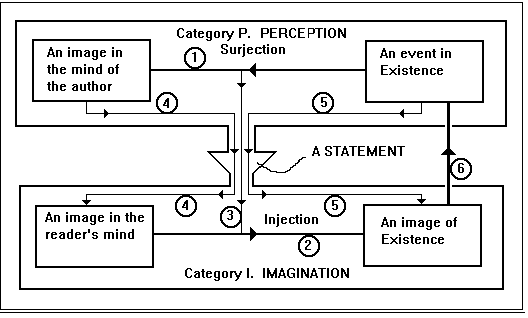
Figure 3-2. Definition of a true statement from a pseudo-functorial viewpoint
[Note. Since we have mentioned peyote, the skeptical reader may argue that the perceiver might be hallucinating and Arrow 1 is not a true surjection. Let us exclude that possibility in our discussion and finesse the question of whether or not hallucinations are “real”. I have a genuine bias when it comes to the notion that psychiatrists have anything to treat. I question the notion of mental illness and I abhor the medicalization of every deviation from “normal behavior”.]
Arrow 2 represents the imagination of the reader, Y. He reads a statement, for example, and he projects the image that appears in his mind into (hence injection) Existence as he perceives it. This all happens in the Category I, principally of imagination. We conceive of imagination, then, as a mapping of an image in the mind into reality. Although the reality where the mapping ends up is the reader’s conception of reality, it is a conception of the same reality perceived by the writer. The injective morphism is g(cy(E)), where cx(E) is Y’s conception of the event, E, obtained by reading the statement. It maps this conception of E into iy(E), the way in which Y, the reader, imagines the content of the statement about E in its appropriate setting, e.g., the Universe or the Ideals, for example. If we may generalize our usage slightly, the statement is a functor, F, mapping perception into imagination. Thus, g(cy(E)) = iy(E).
Since every element mapped by the reader into his conception of reality originates from a unique element in the reader’s mental image of the content of the statement, the (left) inverse map of Arrow 2, gL-1 is well-defined on the relevant part of the reader’s conception of reality. The statement (essentially, but not precisely) maps the author’s perception into the (left) inverse of the reader’s imagination (Arrow 3). (See equation below.) It maps (Arrow 4) the image in the mind of the writer (a point set in his mental space) into a point set in the mental space of the reader, one dimension of which is time. Also, the statement maps the event in reality perceived by the writer into the event in reality imagined by the reader (Arrow 5). Arrows 3, 4, and 5 comprise the statement from the pseudo-functorial view. Arrow 3: F(f(ex(E)) = gL-1(iy(E)). Arrow 4: F(mx(ex(E))) = cy(E). Arrow 5: F(ex(E)) = iy(E). We may represent the pseudo-functor F as a function of three variables:

The success of this process is determined by Arrow 6, P(iy(E)) → ex(E), which is not part of the functor. If the mapping P, for pointer, points toward reality in the sense of Russell [18]; and, the correspondence, element-by-element, is close enough (which almost always depends on context and circumstances, especially usefulness to the reader), we say that the statement is true. If Arrow 6 points away from reality and the reader is not at fault, we say the statement is false. If the reader reads badly, the arrow may point away from reality even though the statement would have been true otherwise. The problem, then, is to determine whose fault it has been when Arrow 6 points in the wrong direction. That is why Arrow 6 cannot be said to be a proper part of the statement. In many cases, particularly in modern advertising, the writer has deliberately set a trap for the reader to ensure that the arrow will point in the wrong direction. Of course, the writer has had to make a judgment about how well the reader will read. He aims his statement at the bad reader with the intention to deceive him. This is falsity and the statement might just as well have been an outright lie from the functorial point of view.
Unfortunately, the notion of intent enters the disquisition. We have already stated that the circumstances under which we can be certain of intent are rarely encountered. The notions of accuracy and appropriateness of the response of a large number of subjects might aid in an inductive proof of malicious intent; however, it is safer philosophically to reject distinctions between wickedness and incompetence (stupidity), which, to the phenomenologist, are indistinguishable anyway. (Phenomenologists consider information that does not come from the direct experience of phenomena less useful than experiential knowledge. Scientists are phenomenologists.) Obviously, we cannot experience the mental state of another person. But, when we are experiencing intense pain or grief the unknown cause of which is the wickedness or stupidity of someone, the possibility that the agent of our misery is an idiot offers little consolation or none. If we are given to blame, we are just as happy to blame the moron as the villain.
Drawbacks of this Approach
Regrettably, a little cloud casts its shadow over our mathematical landscape. The expert at category theory will note immediately that our categories and our functor do not satisfy the conditions of that theory exactly. See Hungerford [17]. The surjections and injections do not satisfy the associative condition because the events are distinct from the other objects in the pseudo-categories. Our use of the term functor should be taken to be an approximate analogy borrowed for our purposes for lack of a better term. Nevertheless, there must be dozens of decent formulations of models of communication among intelligent beings that employ functors and category theory more or less properly. I shall present my latest efforts, for whatever they’re worth, in the next section. [Tarski [10] uses the term functor, too, but in a manner quite distinct from its use in classical category theory – as far as I can tell.]
Second Approach
Let us consider an extremely simple scheme for determining in an impossible thought experiment when a statement is true. This scheme will be diagrammed in Fig. 3-3, however the arrows will not be explained. The objects in Category E are writers and readers who have witnessed (or not) a particular external event E. Let the writer be X and the reader Y. Let us assume that the writer, X, has witnessed the event and, to gratify ourselves, will write a statement about what he saw to be read subsequently by the reader, Y. Now, here’s the thing: In Category E, the morphisms, fi , i = 1,2,3,…, are the transformation of one person into another bijectively. That is, anyone can become anyone else, by executing fk, say, as in the commonplace saying, “If I were you, ...”; and, whenever he wishes, he can transform back into himself by executing fk-1. Naturally, while Y is X, he can see whatever X would have seen had not Y been mapped into him.
The functor P will map within individual minds visual images, say, of a particular external event E into conceptions of E. The functor P is essentially what we mean by perception. Let g[Cx(E)] be the simple associative surjective morphism that amounts to no more than X, the writer, providing Y, the reader, with a written account of the event E.
Then, the functor P maps, in addition, the extremely awkward morphism f-1(X) into the extremely convenient morphism g(Cx(E)). The written statement g maps the percept Cx(E) = P(Vx(E)), which is the writer’s perception of his own visual image of the event E, into Cy(E) = g[P(Vx(E))], the reader’s conception of the statement g.
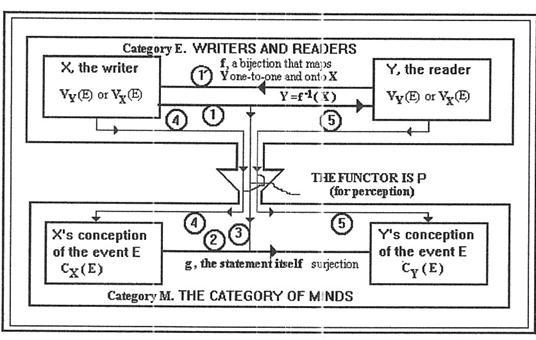
Figure 3-3. Second approach to the definition of a true statement
To determine the success of the communication (or if the statement be at all true), we consider a surrogate for Cy(E), namely,

This is the conception Y would have had of the event E if he had been X when X acquired his visual image of E, which was then perceived by Y. If Cy*(E) is very close to Cy(E), it is difficult to see how a statement could do better. Obviously, writing is easier and a lot more fun than having oneself changed into someone else – even if we were permitted to disregard the impossibility of doing so. Then, if X’s perception be correct and X’s statement to Y be true, the condition of Y’s mind is close enough to what it would have been if Y had become X. What we mean by “close enough” was discussed in connection with Arrow 6, above. Between the virtually absolute truth, when Cy* = Cy(E), and absolute falsehood, diametrically opposed to the event E witnessed by X, we can expect every gradation of verity and falsity. What is true enough for one person is a dirty lie for another – depending upon context, circumstances, and personal need. Only in mathematics, logic, fiction (and occasionally elsewhere) do we have a clear choice between true and false.
The inverse of the functor P is the process of imagination that the reader Y employs to visualize the image the writer X is trying to convey. In this model of written communication, the imagination of the reader is not part of the written statement, which seems fair enough, as it is not the writer’s fault if the communication fails due to the reader’s lack of imagination.
Third Approach
This approach involves four categories each of which is simpler than those previously presented. The first Category W consists of various phenomena q, r, s, ... spawned by a distinguished event, E, say. The surjective morphism f maps deeper (further removed from human perception) phenomena into more readily observable phenomena, which some people take to be the objects that are explained by the deeper (and less apparent) phenomena, for example, q could be the events associated with the collision of two neutrons under extremely high-impact energy, and r could be a photograph of a vapor trail in a cloud chamber that recorded a small portion of what occurred. The surjection f is a partial explanation of q.
The functor P maps Category W into Category M, the objects of which are various mental states of the mind of the writer, X, an eye-witness (or very nearly) of the phenomena. The functor P maps q onto P(q), X’s perception of the phenomenon q from his viewpoint. Likewise, for r. Finally, since g is an injection of P(r) into P(q), it is like an explanation of r in the manner according to which we usually explain the more perceivable events with “myths” about the underlying barely knowable phenomena P(f(q)) = gL-1(P(q)). This is more like a description of how q occurred. Since g is an injection, it is (left) invertible on its range.
The objects in Category R are conceptions of the meaning of the statement S in the mind of the reader, Y, or, at least, conceptions that arose because of reading the statement, if we wish to leave ‘meaning’ out of it. The surjection h maps Cy(P(q)) onto Cy(P(r)), i.e., h(Cy(P(q))) = Cy(P(r)). The functor S maps P(q) onto Cy(P(q)). Also, S(P(r)) = Cy(P(r)). Finally, S(gL-1(P(q))) = h(Cy(P(q))). The functor S is the statement. Whether or not it be true and understood depends upon the resemblance of q*, f*, and r*, described below, to q, f, and r, which can vary from (nearly) the identity to (nearly) the opposite, i.e., a perfect misrepresentation.
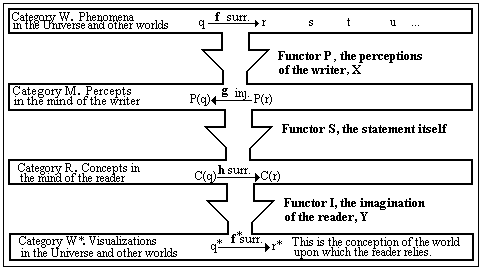
Figure 3-4. Third approach to the definition of a true statement
The objects of the fourth category, Category W*, are the phenomena perceived by X projected by Y’s imagination into his (Y’s) conception of the world, W*. These are Iy(Cy(P(q))), etc., which have been simplified already. Let us simplify further and call them simply q*, r*, etc. The imagined projection of the morphism f will be called f*. It maps q* onto r*. The functor I, between R and W*, maps Cy(P(q)) onto q*; Cy(P(r)) onto r*, and h(Cy(P(q))) onto f*(q*).
Fourth Approach
Finally, we can simplify the third approach by simplifying the categories to categories each containing one object (only), such that the sole morphism is the identity. Let Category W have one phenomenon, call it q. Category M has only X’s perception P(q). Category R has Y’s conception of what the statement S means, namely, Cy(P(q)). The functors P , S (the statement), and I map q to P(q) to Cy(P(q)) to q*. The statement S is successful if q* resembles q.
Examples of Failed Communications, Usually Purposely Deceptive
Herman Melville in his famous masterpiece The Confidence Man produces hundreds of statements that are intentionally designed so that Arrow 6 will point the wrong way. The reader soon discovers that he himself, rather than a character in the book, is the “mark”. (A mark is the victim of a confidence man’s schemes, i.e., the person swindled.)
In the unfortunate case where one watches TV (perhaps because he is an incurable baseball fan), it is advisable to take notes while watching and keep track of all of the falsity one encounters. The other day I saw an ad in which the viewer is told (by implication) that he (or she) ought to patronize an auto parts company because it doesn’t put on sales and, after all, auto parts companies that do have sales probably won’t have the part you want on sale anyway. This points away from the fact that the prices at the store being advertised are not lower than prices elsewhere.
You receive a postcard that says you have already won one of five prizes. The image of the least valuable prize that pops into your head is worth many times the prize the swindler intends to “give” after you have paid shipping and handling, say, that costs far more than what the “prize” is worth. The correspondence in its essential elements is not close enough to consider the swindler’s statement true – although a machine that can parse English sentences might deem the statement congruent with an accurate statement of the actual case. That is, the swindler might escape jail because, in a dictionary sense, what he says is strictly true, but he has conspired to make Arrow 6 point in the wrong direction, namely, at something quite different from what the mark imagined. In my essay on television in Vol. III of my collected essays [18a], I shall give a large number of examples of this form of falsity, including statements made by some of the most highly respected organizations in the world, i.e., respected by some.
In a lighter vein, the King in “The Lion and the Unicorn” in Through the Looking Glass [24] abuses truth in a humorous way. He exclaims, “There’s nothing like eating hay when you’re faint.” When Alice suggests that throwing water over oneself or taking (sniffing) sal volatile (smelling salts) would be better, he insists that he didn’t say there was nothing better than eating hay, only that there was nothing like eating hay. The King, of course, is being silly; but, if he were serious, we should accuse him of intentionally deceiving us because, in colloquial speech, when we say “nothing like” we mean “nothing better”. He knows this as well as we do and ought to understand that we will take “nothing like” to mean “nothing better”.
Here’s a trick that illustrates how we may confuse our listener. (I stray from our specialization to the printed word.) Sitting in the cafeteria of a famous university with a famous philosopher, looking across the East River, I ask, “Which of those three smokestacks are farthest apart? Without hesitation, he answers, “The two on the left.” (He may have said “right”, but that’s irrelevant.) “What about the two on the ends?”, say I. He has been had. Naturally, he supposed I have asked him to make a judgment and, since the three smokestacks do not appear to be evenly spaced, he assumed I was asking him to make a judgment about their spacing. That’s a fair assumption. What is fair to assume does not correspond to the accurate parsing of the sentence. As a joke this is fine. It would be immoral to place a money bet on his answer – according to my moral system, which I claim is complete and the best one can do. I await the reader’s criticism.
I can’t resist giving you one more example: I shall tell two stories – one true, the other false. Remember, these are normally given orally, so don’t “study” the versions. Just read quickly out loud and make your choice. Please decide which is which without looking at the text after the first reading and before I reveal the answer in the last paragraph of the main part of this chapter (not the appendix). Here goes:
1. There’s a little town in Iowa. The main street is a continuation of the state highway. At one end of the main street there’s a fire station. Across the street from the fire station there’s a general store. In front of the general store there’s a big wooden block. On top of the big wooden block there’s a big wooden Indian. Whenever the firebell rings the big wooden Indian jumps down off the big wooden block and chases the fire engine.
2. There’s a little town in Iowa. The main street is a continuation of the state highway. At one end of the main street there’s a fire station. Across the street from the fire station there’s a general store. In front of the general store there’s a big wooden block. On top of the big wooden block there’s a big wooden Indian. Whenever the big wooden Indian hears the firebell he jumps down off the big wooden block and chases the fire engine. Remember, don’t look at either version again until you decide. I’m afraid it’s too easy.
Tarski’s Theory of True Statements
The White Knight’s story in Through the Looking Glass [24] may be useful to understand Tarski’s arguments. (It helped me understand computers!)
“··· The name of the song is called ‘Haddock’s Eyes.’ ”
“Oh, that’s the name of the song is it?” Alice said, trying to feel interested.
“No, you don’t understand,” the Knight said, looking a little vexed. “That’s what the name is called. The name really is ‘The Aged Aged Man.’ ”
“Then I ought to have said, ‘That’s what the song is called’?” Alice corrected herself.
“No, you oughtn’t: that’s another thing. The song is called ‘Ways and Means’: but that’s only what it’s called, you know!”
“Well, what is the song, then?” said Alice, who was by this time completely bewildered.
“I was coming to that,” the Knight said. “The song really is ‘A-sitting on a Gate’: and the tune’s my own invention.”
In computer programming one must distinguish carefully among the following objects: (i) a datum (a number, say), (ii) the address of the datum, (iii) the name of the datum, and (iv) the address of the name. For example, X = 255; 255 is stored in location 1025 in RAM; 255 is called X, in our case because that is its name (no subtle knightly distinctions between names and what things are called for us); the name X is stored in its own location in RAM with its own address – 2049, say. The name of the datum may appear in a number of places. For that matter, so may the datum. So, it’s no good saying that it is a truism that every object can be in only one place at a time. (OK, you wish to quibble? The symbols “2”, “5”, and “5” are only the components of my name for the representation of the datum. This representation is the binary number 11111111, but the actual representation is a sequence of charged electronic devices, each capable of designating one bit. The datum itself is an abstraction. It is an equivalence class dwelling in the Realm of Ideals. One can really appreciate the difficulty Tarski is concerned with in defining a true statement in colloquial language. Look at the difficulty I’m having here. It’s conceivable that we could make things worse by trying to be too accurate. There is something to be said for leaving a statement alone when the reader gets the point.) The point is that things have to be kept separate from their names.
In symbolic logic, statements are given names. In every case, they can be given names that are the statements themselves in quotation marks; i.e., the name of the sentence It is snowing is “It is snowing”. These are called quotation-mark names! In the example below the same sentence is given three names: (i) c, (ii) “c is not a true sentence”, and (iii) the sentence set off by asterisks. Obviously, it is important to distinguish a statement from a name of a statement. In the case of (ii) above, the name of the sentence contains another name of the sentence. Also, the name contains the sentence itself.
Tarski [10] has explored thoroughly the possibility of defining rigorously the concept of a true statement. Tarski has successfully defined a true statement within the narrow bounds of a specialized logical language – such as the language of Russell and Whitehead [25]. On the other hand, he has more or less proved that a true statement cannot be defined within the context of ordinary colloquial language. (What he actually showed was that all of the techniques that have been employed so far to define a true statement in ordinary colloquial language have been unsuccessful. He didn’t show that no technique can ever be found.) The machinery required to give the proof is beyond the scope of this discussion – and we really don’t need it. Most of the counterexamples he chooses are quite pathological and of no genuine practical interest. For example, suppose we name the sentence set off by triple asterisks just below as the sentence c, i.e., c is the name of the sentence set off by asterisks.
*** c is not a true sentence ***
We notice two facts: (1) “c is not a true sentence” is identical with c, i.e., “c is not a true sentence” = c = the sentence set off by asterisks, and (2) “c is not a true sentence” is a true sentence if and only if c is not a true sentence. (1) and (2) taken together give the contradiction that c is a true sentence if and only if c is not a true sentence.
According to Tarski, the difficulty arises because the sentence c contains the words “true sentence”. (In my naiveté, I would guess that the paradox occurs because the sentence refers to itself by name.) Perhaps this is analogous to Russell’s famous paradox [26] concerning the set of all ordinary sets. Russell’s paradox can be avoided by defining classes first then defining sets in terms of classes – but more restrictively. This has been done at the beginning of the book on algebra by Hungerford [17]. I do not believe it will present a serious difficulty for my theory. I am encouraged in this belief by two observations:
1. Basically, everyone knows intuitively what a true statement is. I realize this is a dangerous assumption.
2. But, in this essay, we shall rely mainly on macrofacts, which are easily verified, as opposed to microfacts – as discussed previously.
In point of fact, we are most often concerned with statements that are false. Obviously, whatever technical difficulties lie in assigning truth to statements having truth value are shared by the problem of falsehood. But, in the normal case, the difficulties do not arise. Although it may be difficult to define rigorously a true statement, no such difficulties exist in the case of falsehood – at least in the case of the falsehoods in which we shall be interested. “Falsehood is so unexacting, [it] needs so little help to make itself manifest!” [Proust] This shall be expanded upon, mostly by example, in the chapter on falsity. I realize that I may be skating on thin ice here. With about two more years of study either (i) I would feel more confident thinking about mathematical logic or (ii) I would avoid it like the plague. Many a vessel more seaworthy than mine has come to grief on the rocky shores of mathematical logic.
The Statement of the Truth Axiom
Axiom 3 (The Truth Axiom). Every person shall promote the truth, the whole truth, and (in the class of statements that possess truth value) nothing but the truth. Truth shall be exalted to the greatest extent possible – to such a great extent, in fact, that it must be withheld from those in authority, who are unworthy of it. (We don’t expect a member of the French underground to tell the truth to the Gestapo!)
Justifying the Truth Axiom According to the Three Criteria
Aesthetics
“Truth is beauty and beauty truth.” We all love the truth because of its beauty. This is what drives (or used to drive) scientists, probably more than curiosity. In fact, it is probably safe to say that the aesthetic pleasure derived from watching the truth, new truth, unfold gradually is an important component of what we call scientific curiosity, which I have tried to make clear in my essay “On Honor in Science” in Vol. II of my collected papers [6].
Reasonableness
Truth is at the heart of reasonableness. Reasonableness is our first criterion for assessing truth. If a statement fails the test of reasonableness, we will require some powerful logic to overwhelm our objections, and yet, for many readers, many of the ideas presented in this essay will strain the sense of what is reasonable. I maintain that such readers aren’t looking at things the right way and, as soon as they shake off old untrue prejudices, they will see that these ideas are entirely reasonable.
Utility
Finally, truth meets the test of utility. Imagine a world where no one could depend on the truth of any statement. That should not be difficult to do. We have very nearly achieved it. When my doctor tells me I have such and such wrong with me and I require such and such treatment, I must believe that what he tells me is true or seek a second opinion. The mere suggestion that I cannot believe my doctor or my dentist is horrifying. I would like to believe my auto mechanic too, and, in fact, I do, but mainly because I know him and I know my car. Truth is useful and falsehood is damned inconvenient, to say the least.
[Note in Proof (7-28-96). When I wrote the earlier drafts of this chapter it did not occur to me that truth needed an elaborate defense. I imagined that nearly all reasonable people saw that, at least among friends and colleagues (but not between ourselves and our enemies), truth needed no defense. I knew that business, especially the sales and marketing aspect of business, embraced falsity, but I supposed that even they knew that what they were doing was immoral and harmful. Lately, I have observed a disturbing trend and, perhaps, I am the last to notice it. Social activists and other so-called world betterers are beginning to adopt the techniques of business, government, and politics to achieve what they still believe are desirable ends; i.e., they are employing deception, half-truths, hidden agendas, equivocation, double meanings, and specious reasoning to influence people whom they would someday like to consider friends and allies. (It would be a different story if they were hoodwinking their sworn enemies, the enemies of society – hopefully.) I believe this is wrong and harmful. Clearly, it is a violation of the Truth Axiom and, therefore, a violation of the morals proposed by me.
Remember that we said that relatedness was a requirement for happiness. Clearly, it is important to have a good relationship with people you wish to include in your expanded family of man – your friends and allies and those who will become your friends and allies if you can convince them that you are part of the solution to their problems or the problems of others that they wish to correct, e.g., starvation in the Third World. How can you have a good relationship with people you lie to or upon whom you practice falsity to gain their confidence? What will they take you for? What should they take you for? Just another phony who wishes to exploit them for his own personal gain. Can you blame them? Is it not essential to establish a relationship of complete trust with all such people and how can that be accomplished except through uncompromised truthfulness! Please keep this in mind when I discuss the harm done by falsity in Chapter 8 and social change in Chapter 12. Unexpectedly, this has turned out to be a pivotal point in advancing this theory. Lately, I have been vilified for speaking the truth (within the drug policy community). Moreover, my detractors are terrified that I will speak the truth in public. They have said as much using precisely those terms!]
Immediate Corollaries of the Truth Axiom
I am tempted to take another crack at absolutist religionists here, who purvey a brand of nonsense that they try to pass off as truth whether it contains an element of truth or not, but I have devoted an entire essay to them in my collected papers [6], which was published also by some friends [21]. This essay, “On the Separation of the State from the Christian Church and the Case Against Christianity”, concentrates on the only religion I know well as I am a former believer. Actually, my philosophy is derived from Christianity. Naturally, I consider my philosophy a vast improvement (but not the last word).
Note. We need to say a word about nosiness and the invasion of privacy, which should not be encouraged by virtue of their compatibility with the Truth Axiom. A judgment about the importance of a piece of information or the suitability of its transfer has a truth value too.
Corollary 6. To represent something as something that it is not is immoral except in the context of a proper game or in one’s dealings with authority. (I do not mean to disparage the play-action pass, a deceptive maneuver that belongs to the popular American game football.)
Corollary 7. One’s behavior must be congruent with one’s moral, political, religious, philosophical, and artistic values, in short, everything one thinks.
Example. When a musician, for example, performs a given piece of music, in addition to the statements in the language of music that are rendered thereby, the musician is making a statement about his aesthetic judgment, presumably that he approves of this piece of music. Now the musician knows whether he (or she) approves of this piece of music or not, but we don’t. We interpret the playing of a piece of music of which the musician approves as truth and the playing of a piece of music of which the musician does not approve as falsehood, which can be remedied only partially by a plain announcement of disapproval both before and after the rendition. This renders a lie true only in a limited sense. Can you imagine Lawrence Welk’s entire band standing up before the first piece is played to announce that they don’t approve of the style in which they are about to play; but, if that’s what the audience wants, well, they’ve got to eat! Actually, L.W.’s band was interviewed by one of the popular music magazines years ago and, according to the interview, they didn’t approve of Welk’s music. (Shakespeare announced pointedly that he did not approve of what he was writing in the title to As You Like It.)
Example. While there is no accounting for taste, it would be a violation of Corollary 7 deliberately to promulgate ugliness for some ulterior motive such as to gain the sympathy of persons whose taste is less developed than one’s own, as one might do to sell a product, particularly if that product were a work of “art” or a form of entertainment. Also, in the selection of alternatives in the exposition of science, mathematics, and logic, this corollary should be observed.
Concrete Example. The promotion of inferior popular music, music that the promoter or artist finds repulsive, is immoral.
Corollary 8. Each person shall follow his or her innermost feelings and the dictates of his or her own heart.
Corollary 9 (The Fundamental Premise). It is unreasonable to be happy when others are miserable or when the misery of posterity is inevitable.
Proof. It is assumed that no reasonable person can be happy while in the presence of misery. Happiness is meant in the technical sense, which implies satisfaction. Even the momentary happiness that comes from seeing an improvement in the condition of the miserable person will not satisfy the technical definition of happiness given in Chapter 1. If a reasonable person were satisfied with the state of affairs even though he knew (with certainty) that people were enduring misery at a far-distant place or were certain to endure misery in the future, he would be denying the truth of what he knew about the present or future condition of those people, which he could not do if they were in his presence. This is at variance with complete respect for truth as required by Axiom 3 because it implies that events far away in space or (future) time do not occur.
Note. It is not clear how knowledge of misery in the distant past would impact upon the happiness of every reasonable person. At least, I have nothing to say on the subject.
Comment. A reasonable person may temporarily disregard a fact of which he is aware if he is not constantly reminded of it; but, eventually, that small nagging inner voice will remind him of the unpleasant situation he has temporarily forgotten. Temporary forgetfulness of misery is not happiness.
The Truth Axiom in Education
The relevant definition of education given in the Random House Dictionary [11] is as follows: Education: 1. The act or process of imparting or acquiring general knowledge and of developing the powers of reasoning and judgment. 2. - 5. (irrelevant – for our purposes). Let us agree that special interest groups are not interested in developing our powers of reasoning and judgment; therefore, if they are educating the public, they must be imparting information. Clearly falsehood ought not to be classified as information under this definition, moreover half-truths might just as well be false. Also, a statement that has an unknown truth value might be uttered as though it were true. This, too, is a form of falsehood. Information that qualifies as educational, then, consists of true statements.
But even if we speak only the truth our statements may not qualify as educational. It is possible to speak the truth but not the whole truth and thereby deceive our listener. Deception should not qualify as informational. Let us agree to consider partial truth and falsehood as non-educational. I think it will assist the reader if I give some examples of educational statements and non-educational statements. All sorts of statements qualify as non-educational, however the non-educational statements in which we are interested constitute propaganda, indoctrination, and brainwashing (used in its ironic sense).
Marijuana is a harmful drug is a non-educational statement. The educational statement is “Some people believe marijuana is harmful; others do not.” Another non-educational statement is “Atheists are trying to drive God out of the public schools.” This is silly because atheists don’t believe in God and theists don’t believe God can be driven here and there. The educational statement is “Atheists are trying to prevent the word God being used in the public schools without qualification.” “Global warming is occurring” is a non-educational statement. An educational statement would be “Computer simulations show that, if the concentration of carbon dioxide in the atmosphere were increasing, the average global temperature would increase – other things being equal.”
To reiterate the beginning of the introduction to Chapter 2, I claim that most of the contents of Chapter 2 qualify as educational under both aspects of Definition 1 because: (1) what I tell you is factual (unless I make an error, which, of course, is always possible despite my best intentions) and is not propaganda or indoctrination and (2) availability, emergy analysis, balance equations in general, and systems diagrams are powerful tools for reasoning and making judgments. (The material given there is easily checked, therefore the danger of unintentional errors is minimized.) This is in contradistinction to many other discussions of the environment (whether pro or con). Actually, most of what most special interest groups are calling education is merely propaganda. Even my attempt to sway the reader away from the hard energy philosophy toward the soft energy view should be considered propaganda rather than education.
Answer to the Puzzle about the “Little Town in Iowa”
Since the wooden Indian does not move until he hears the firebell and wooden Indians can’t hear and never do hear, the second story is true. (The first story would have the wooden Indian moving “whenever the firebell rings”, which is impossible.)
References
1. Herman, Edward S. and Noam Chomsky, Manufacturing Consent, Pantheon, New York (1988).
2. Chomsky, Noam, What Uncle Sam Really Wants, Odonian Press, Berkeley, CA (1992).
3. Chomsky, Noam, World Orders Old and New, Columbia University Press, New York (1995).
4. Bentham, Jeremy, Bentham’s Handbook of Political Fallacies, Ed., Harold A. Larrabee, Johns Hopkins Press, Baltimore (1952).
5. Deci, Edward L. and Richard M. Ryan, Intrinsic Motivation and Self-Determination in Human Behavior, Plenum Press, New York (1985).
6. Wayburn, Thomas L., The Collected Papers of Thomas Wayburn, Vol. II, American Policy Inst., Houston (Work in progress 1997).
7. Wayburn, Thomas L., The Collected Papers of Thomas Wayburn, Vol. I: Drug Policy 1986-1996, American Policy Inst., Houston (1996).
8. Häfele, Wolf, Editor, Energy in a Finite World, Ballinger, Cambridge, MA (1981).
9. Webster’s New Collegiate Dictionary, Henry Bosley Woolf, Editor in Chief, G. & C. Merriam Co., Springfield , Massachusetts (1977).
10. Tarski, Alfred, “The Concept of Truth in Formalized Languages”, in Logic, Semantics, Metamathematics, 2nd Ed., Ed., John Corcoran, Trans. J. H. Woodger, Hackett, Indianapolis (1983).
11. The Random House Dictionary of the English Language, Lawrence Urdang, Editor in Chief, Random House, New York (1968).
12. Webster’s Deluxe Unabridged Dictionary, 2nd Ed., Simon and Schuster, New York (1983).
13. Barker, Stephen Francis, Elements of Logic, McGraw-Hill, New York (1974).
14. Popper, Karl R., Conjectures and Refutations, Harper, New York (1965).
15. Lakatos, Imre, Proofs and Refutations, Cambridge University, New York (111976).
16. Einstein, Albert, Sidelights on Relativity, Dover, New York (1983).
17. Hungerford, Thomas W., Algebra, Springer-Verlag, New York (1974).
18. Russell, Bertrand, “Truth and Falsehood” in The Basic Writings of Bertrand Russell, Eds. Robert E. Egner and Lester E. Denonn, Simon and Schuster, New York (1961).
19. Wayburn, Thomas L., The Collected Papers of Thomas Wayburn, Vol. III, American Policy Inst., Houston (Work in progress 1997).
20. Fraser, James George, The Golden Bough: A Study in Magic and Religion, 3rd Ed., St. Martin’s Press, New York (1963).
21. Wayburn, Thomas L., “The Separation of the State from the Christian Church: Parts 1, 2, and 3”, The Truth Seeker, 117, Nos. 2, 4, 6 (1990).
22. Wayburn, Thomas L., “The Separation of the State from the Christian Church and the Case Against Christianity”, The Philosophy of Humanism and the Current Issues, Marian Hillar and Frank Prahl, Eds., Humanists of Houston, Houston (1995).
23. Tarski, Alfred, Introduction to Logic and the Methodology of the Deductive Sciences, Oxford University Press, New York (1994).
24. Huxley, Aldous, The Doors of Perception, Harper, New York (1954).
25. Carroll, Lewis, “Through the Looking Glass” in The Lewis Carroll Book, Ed. Richard Herrick, Tudor, New York (1931).
26. Whitehead, Alfred North and Bertrand Russell, Principia Mathematica, Cambridge University Press (1912).
27. Penrose, Roger, The Emperor’s New Mind, Oxford University Press, New York (1989).
Appendix: Why Taking Drugs Per Se Imposes on No One
Pleasure, after all, is a safer guide than either right or duty. For hard as it is to know what gives us pleasure, right and duty are often still harder to distinguish and, if we go wrong with them, will lead us into just as sorry a plight as a mistaken opinion concerning pleasure. When men burn their fingers through following pleasure they find out their mistake and get to see where they have gone wrong more easily than when they have burnt them through following after a fancied duty, or a fancied idea concerning right virtue. The devil, in fact, when he dresses himself in angel’s clothes, can only be detected by experts of exceptional skill, and as often does he adopt this disguise that it is hardly safe to be seen talking to an angel at all, and prudent people will follow after pleasure as a more homely but more respectable and on the whole more trustworthy guide. – Samuel Butler, The Way of All Flesh
Pryer (a de jure clergyman and a de facto stock swindler): ... [N]o practice is entirely vicious which has not been extinguished among the comeliest, most vigorous, and most cultivated races of mankind in spite of centuries of endeavor to extirpate it. If a vice in spite of such efforts can still hold its own among the most polished nations, it must be founded on some immutable truth or fact in human nature, and must have some compensatory advantage which we cannot afford altogether to dispense with. – Samuel Butler, The Way of All Flesh
Comment. In the “Preface to The Millionairess”, G. B. Shaw claimed Butler was the greatest of the nineteenth century novelists. Notice what a skillful architect of language he was – despite the occasional less-than-optimal choice of word, owing, no doubt, to hurried composition. Indeed, Butler did not survive to see his masterpiece, The Way of All Flesh, in print. The second quote, placed in the mouth of the scoundrel Pryer, may be supposed to be facetious; however, as Shakespeare gives that old rat Polonius “To thine own self be true, etc.”, why should not Butler place his own radical opinion in the mouth of whomever is speaking when the inspiration came? I like this thought independently of its source.
Please see “The Case for Drug Legalization and Decontrol in the United States” at http://www.druglibrary.org/schaffer/DEBATE/dpf89.htm and “We Must Prove Drugs Are Good and Laws Are Bad” at http://www.dematerialism.net/crucial.htm.