My Story
Chet Baker and Philly Joe Jones
I believe it was in 1958 that Chet and Philly Joe Jones lived with me on East 20th Street (close to where Theodore Roosevelt was born but rent controlled at $19.05/ month). Chet's father came to visit him. Chet's dad and I drove uptown to pick up Chet at his connection's place and "Dad" told me about his (Dad's) days playing banjo with Charlie Teagarden's band. (Charlie was Jack's brother.) Also, he related a discussion with Chet throughout which he gave all the arguments for sticking with "pot" and leaving heroin alone. This was before Chet had tried heroin. I have many additional stories from those days but I am growing old. Chet and Philly Joe continued to reside in what must have been the poorest accommodations in New York with no lights, no phone, and no furniture except mattresses on the floor. Joe and I played piano and drums pretty often; Chet and Joe scored dope daily or almost daily; occasionally I bought a small bottle of Cosanyl cough syrup -that got me as hammered as Chet and Joe much to the chagrin of the illegal drug users, although Cosanyl was just as unhealthy when it was used like that.
.
.
.
Earlier I mentioned that I had more than two sets of drums. While I was still employed as a chemical engineer. I had enough money to collect drums as opportunities arose. A had a couple of tom-toms that I no longer had plans for; so, I begrudgingly agreed that Philly Joe could take them to someone he knew in Brooklyn who would give us money that could be used for drugs. We took my car to Brooklyn. Chet was the designated driver. He looked nearly as much at home behind the wheel of a car as behind a trumpet. (I would have been willing to believe he was the second coming of James Dean in those days.) Although, it was already late in the evening, Joe took the two drums and left Chet and me ( respectively) in the front and back seats (respectively) where we promptly fell asleep. Now Joe had no intention to share the proceeds from the sale of the drums. He never returned to the car. Nor did Chet and I wake up until well after dawn.
As it turned out, Chet had a record date at Riverside Records later that day but not that much later. He had no intention to make a record while enduring the beginnings of drug withdrawal; so, we headed for the bridge to Manhattan and Chet's uptown connection. But, just before we got to the bridge, out of gas we ran – and we with very little cash. Chet said, “No way do I play that record date without scoring first. I am going to walk over the bridge and take a train up to Harlem.” I said, “Look! There's a gas station over there [less than a block away].” I could fill a gas can with the pocket change I had on me and we would be on our way very quickly. For some strange reason, he was having none of it. As he disappeared into the ironwork of I forget which of the three bridges (I think it must have been the Manhattan), I was reminded of the ending of some movies (such as Chaplin in Modern Times) and I never saw him again except for a few minutes backstage at Carnegie Hall (to be described later).
As I understand it, he was busted later that day, made bail, and escaped to Italy.
From a letter to Biography
You ought to check that Birdland was really named for Bird and not because it reminded someone of a birdcage as another source states. Personally, I have only the following, which is ambiguous. I knew Charlie Parker slightly. We were walking down Second Avenue together near St Marks Place when we heard a youthful voice yelling my name (Tom ... Tom Wayburn). It was a recent graduate of Redford High School in Detroit who knew who I was although I was a year or two ahead of him. He was accompanied by another Redford High School graduate who also remembered me. After a minute or two, one of them recognized Charlie Parker. "You're Charlie Parker," he said. Bird answered, "Yeah, they got a club up on Broadway named Birdland; but, that don't mean nothing." Now, he might have said "named after me"; but, that may not have been true. However, it was 66 years ago; so, I'm doing well to remember anything.
Email to Katja von Schuttenbach
Jutta gave me a drawing she had made of Billie Holiday, which I displayed in a prominent place on the wall of my $19.05/month railroad flat on East Twentieth Street. Since Jay Cameron got me this remarkable deal, presumably so that there would always be a place where we could play our music where there was a set of drums and a tuned piano, he felt free to suggest various room mates from among his vast circle of friends in the jazz world who needed a place to live. At the time, it was the fine drummer Richie Goldberg, who is certainly not any more Jewish than I am. One fine day Pannonica de Koenigswarter brought Thelonious Monk over to visit Richie. While Richie sat at my drums, I sat with the baroness on my mattress on the floor. She spotted the drawing by Jutta immediately; and, she knew that Jutta had drawn it. “I don't care for Jutta Hipp's drawings. They are too sad.,” she drawled, thus revealing that they had had a non negligible impact on her. I said that I liked it very much and it helped me remember something rather important. We then concentrated on Monk and Richie playing for a very pleasant interlude.
When I was living at 49 Horatio Street and Jutta was living at 47 (sounds like the verse of a song that is about to be sung by Judy Garland), I saw her a lot, especially at the evening sessions. Even afterward, Peter invited her to one of our camping trips, I spent additional social time with her. Peter had ground the lens for a 10” telescope that was good enough to rate a trip into the country to escape light pollution. I often went along on these trips. I am an experienced camper. One night Jutta invited me to dinner for German chop suey, which she cooked, although I say “cooked”advisedly since German chop suey uses raw meat, which was delicious. Jutta got a kick out of informing me the meat was raw half-way through the meal. I hope I didn't disappoint with my non-reaction.
I remember, in particular, an evening session at 47 Horatio where we had the privilege to be among the first New Yorkers to hear Bill Evans. Years later I asked Bill if he remembered that night when after he played Jutta said, “Horace Silvers was my favorite pianist, but no more.” He said he remembered it well.
Email to Charlotta Hayes in Stockholm
I guess I should be delighted that a handful of people are interested in what we were doing back then - when we had no idea we were making history. I have been off drugs now since October 3, 2003. (I got my PhD in chemical engineering in 1983; so, the 20 years prior to losing interest in drugs were spent in a variety of ways.) Therefore, it's easier to talk about a period of intense drug use. We knew that many times our playing suffered because we were on drugs; but, we lived for that rare moment when we could see and hear EVERYTHING. In any case, since I quit drugs, I have not played with anyone. I have forgotten all the music I was learning at the time. My drums and electric piano are set up, but I rarely play them. I have not replaced the set of vibes that the movers between Salt Lake and Potsdam, New York, destroyed. Even so, I enjoy music more now than I did when I was playing it. Something about the ego.
I'll bet you thought I was going to talk about Karen and me except leave out Karen. Well, no.
I wish I could remember what the date was the first time I met Karen. It was sometime in the 70s; so, let it be 1975 until we know better. My friend Terry Pippos, the former child-prodigy tenor sax player who was at the time adding rock and roll electric bass to his portfolio, had landed a job with Karen Dalton for a coffeehouse or bar gig and I had accompanied him to a Greenwich Village music studio where Terry, Bobby Notkoff, a violinist who had played a recital in Carnegie Hall while still a child, Frank Steo, the jazz and rock drummer, and one or two others were anxiously awaiting Karen. When it was finally determined that Karen was home in bed asleep, I was dispatched with cab fare and specific instructions as to how to get to Karen's and an urgent mandate to bring her back to the "rehearsal" ASAP. "I came, I saw, she conquered." I rang her bell, heard "Come in," and found a beautiful lady in bed who greeted a perfect stranger with the sweetest smile I have ever been smiled upon with. I have loved her ever since, although I was living with Ellen then and I still am. It's true that Karen and I became friends immediately but never lovers, which is why (perhaps) our friendship was so steady. If I may be excused, I promise to add a paragraph or two.
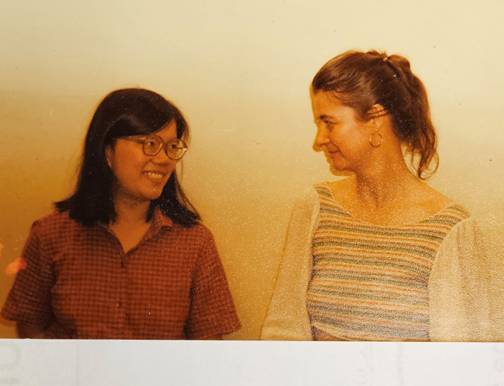
My wife, Ellen Lee, and her friend,
Karen Dalton
Hunt Middleton's Seventh Avenue loft where Karen was living was a quick walk from my loft at 821 Sixth Avenue. I spent a lot of time at Hunt's where we could play music in the middle of the night. I found that most jazz musicians who heard Karen liked her singing; therefore, it soon occurred to me that, perhaps, I could hear Karen with a jazz rhythm section. Chris Anderson and Gino Biondo, the jazz bass player who played mostly classical gigs, were among the jazz musicians who played with Karen.
To Ludovic Ernault
I was much attracted to the capital city of jazz and bebop in the old days. I visited during the Redford High-School Senior Trip of 1951 with the fake ID needed to enter the bars and listen to music. Actually, Ross Naidow and I traveled concurrently but independently of the official trip, presumably to retain as much personal freedom as possible. That was an eventful few days I remember being treated better when I could spend my father''s money rather freely than I was when I finally entered legally with only my own money to spend and that rather tight-fistedly. We stayed in a hotel where, according to the desk clerk, Boyd Raeburn's band had stayed with 26 men sleeping in one room if that's to be believed. (Boyd' Raeburn had a modern band that played Night in Tunisia with it's original title Interlude and Fran Warren singing Happiness is Just a Thing Called Joe, a beautiful song that the great Ethyl Waters made famous in Cabin in the Sky.) We visited Arthur's Tavern in Greenwich Village where jam sessions went on nightly. From the very first, Jerry, the owner and bartender, hated me. Maybe it had something to do with how ineptly I played the brushes on the snare drum, the sole representative of the drum set on the premises, a responsibility that he reserved for himself and which he discharged more gracefully than I was able to do it. We set out one early evening for Minton's Playhouse in Harlem by walking up Broadway and stopping for a beer in every bar on the East side of the street. By the time we got there, although Ross may not have made it all the way, Eddie Lockjaw Davis, the tenor player, had to put me in a cab and send me back to the hotel. So much for playing at Minton's.
Finally, there is Birdland. Charlie Parker with strings was playing there. Roy Haynes was on drums. I had met Roy earlier when I played in a talent show at the Paradise Theatre in Detroit with my knob-tension drums that did not require a drum key to tune them. They were beautiful and very expensive. Someone said, “What are you going to play when you're with Woody Herman. Wait 'til Roy sees this.” This was how I got to be friends with Roy Haynes. He would probably still remember me although the last time I saw him was when I asked Zoot Sims for Roy's job with Zoot with Roy sitting at the table in the Half Note. This was sometime before I took my PhD at Utah. (My thesis won an international prize with a cash award of $500. My thesis advisor suggested the overall problem of modelling interlinked distillation columns; however, the idea to apply homotopy continuation was mine as well as every other detail in the solution, which entailed the student teaching the teacher differential topology and other features of modern mathematics. He won a prize with a $10,000 cash award. Sic transit, I relate this so that you won't think that Utah was such a big step down from the Courant Institute, where I am still out on the student strike that began when Johnson bombed Cambodia in May, 1970, 50 years ago. US out of Asia; war machine off campus; end to racism, none of which were achieved.
The first night I brought my girlfriend, and we stayed all night listening to Bird, drinking Flying Dutchman beer, and talking only between sets. The second night I came alone, got a good table, and drank Flying Dutchman beer all night with no talking to anyone. The third night began like the second night until, after one or two sets, Mr. Parker whispered, “Hey you” while looking straight at me. “Me?” “Yeah, you. Come here.” And I found myself sitting next to the great Charlie Parker. I was a little nervous having spent very little time on Mount Olympus previously, which probably accounts for putting my foot directly into my mouth by answering one of Bird's questions thusly, “Yes, I love modern jazz; however, I am very concerned about the great number of my favorite musicians who are addicted to drugs.” “Yeah,” said Bird, “I have a son living in River Rouge, Michigan. If I ever catch him taking drugs, I'll kill him.” I may have the town in Michigan wrong, but not the rest of it. How about that! I remember another extremely revealing statement that Bird made in the basement of 344 West 72d Street, which I will relate in its place.
It was late 1951 or early 1952 that Dave Kelton, a trumpet player, and I met at the University of Michigan where we were freshmen. We played together on a number of ocasions and become friends. Dave had read somewhere that the great Lennie Tristano was giving lessons; so, together, we decided that we would spend summers in New York and study with Lennie Tristano. It was in the summer of 1953 that we took the bus to New York; and, once we got situated, we set out to visit Lennie in his studio. We probably called first and said we'd like to have an interview.
We were standing somewhere around the Third Avenue El (IRT), which was still elevated in those days. Now it's underground, like all the other subways. There was a slight breeze and Dave got a piece of dirt in his eye. It made him so mad that he said, “I'm getting out of this dirty city; I'm going home”. And he did. So, on that day, I continued on by myself to Lennie's studio at 317 East 32nd Street, even though I didn't think I had much of a chance to be accepted as a student.
Yes, I thought it would be hard to be taken as a student of Lennie. But the truth is, he would take anyone. And I was just about as “anyone” as anyone who had ever approached him to study. I was probably the least skilled musicians he had ever attempted to teach. I spent the summer of 1953 practicing in excess of twelve hours per day. When I told Lennie about how much I was practicing, he didn't believe me. However, after spending the summer with him, he said that he now believed what I told him about the lengths of my practice sessions; and, in addition, he said that I had made more progress than any student he'd ever had, including Lee Konitz. And I continued to practice. However, I began to play with other musicians from time to time.
I lived in the basement of the last house on 72nd Street on the the south side of the street, just past Riverside Drive in a building that overlooks the New York Times news print freight yards. Anyway, I lived in a small basement room, large enough for a bed and a piano and a very small table with one chair. When you got out of bed, you were close enough to the piano to play it. It was one story below 72d Street; however, if I looked out my window, I was still about three or four flights above the the level of the freight yards. So that's kind of interesting. That building has three or four basement levels.
In 344 West 72d Street was rented exclusively to musicians. Down the hall was Larry Mortlock who was destined to play a huge role in my life and the lives of others I knew. He played the trumpet in the style of Miles Davis but only with records. Larry introduced me to his friends Ralph and Pam Therian. Ralph had drawn Prince Valiant perhaps briefly as he claimed to earn no more than 50 cents per hour at that. Currently, he was making inverse sculptures in plexiglas cubes with dentist tools to drill out the shape. Like classical sculptors he worked by removing material; however, unlike Michaelangelo, he removed the material corresponding to the object rather than the material in which it was embedded. He played bebop trombone, but not often. The point is that I was meeting co-religionists. The faith we kept was the certainty that bebop represented the highest point so far reached by any music - classical or jazz. Could it be that we were at Peak Music and that even John Coltrane represented the beginning of degeneracy in the same sense that Alban Berg did? Larry Mortlock introduced me to the Lantern Bar on the corner of 52d Street and Seventh Avenue, right next to Birdland, where the musicians, especially the black musicians, hung out between sets at Birdland or between jobs or just to be around masters of our great art. I clearly recall a young Miles Davis, his voice already suffering from the same condition that makes me so difficuilt to listen to, “Tasty! Where's Tasty.” Tasty was the connection. Also, Larry introduced me to Bill Basie. Despite my congenital inability to recognize faces, I quickly realized that I was being formally introduced to the Count. Wow.
Anyway, that's the building where Vince Botari and Charlie Parker, and a couple of other people we're waiting around, early in the morning, for it to get late enough in the morning that we dared to play. The building was rented solely to musicians; but, even musicians sleep at night sometimes. What happened is described by Vince in Robert Reisner's book about Charlie Parker. So we can insert that story parenthetically at this point or save it for later. Suffice to say that the events of that morning got me evicted; however, in those days one could get an apartment in New York City fairly easily. I moved to 75th Street, west of Broadway and immediately began soundproofing my room.
Later on in the year, after I returned to Ann Arbor and Detroit, I went to see Max Roach and Clifford Brown. Max, who claims to have heard me play and liked it, shared my political views. He introduced me formerly to Clifford Brown. You have no idea how much that meant to me. I would now like to discuss my Greenwich Village adventures.
The summer was drawing to a close, I really did not want to leave New York. So I arranged matters to transfer to CCNY for just that one semester and take elective courses. I wanted to take all my engineering courses at Michigan. That was probably a mistake; however, I managed to extend my study with Lennie until the Spring semester and Lennie gave me plenty to work on when I got back to Ann Arbor.
So I stayed in New York that whole fall, during which time I met Charlie Parker and lots of other people. And the deal was to hang out at The Open Door, which was referred to as the Open Sore, for good reason. It was a dirty place in Greenwich Village that was not attractive enough to be a tourist trap. There were jam sessions every night, and some really good players would come by. So it wasn't automatic that I would get a chance to play. But, I met Don Joseph, Jumior Collins, Dudley Watson, Bob Whiteside, Tony Fruscella, Bill Heine, and many others there. I am trying to think of the name of the tenor sax player who was one of the most dangerous people I had ever known. His claim to fame was that he had been the room mate of Franz Klein, the abstract expressionist. Charlie Parker played there a few times. On one such occasion, he sat at the table with my friend Sidelle Cohen, whom I had net at CCNY, and me and smoked nearly all of Sidelle's Camels. Lennie Tristano smoked Camels. I began to smoke this lethal brand of cigaret too (always unfiltered) until that idiocy wore off.
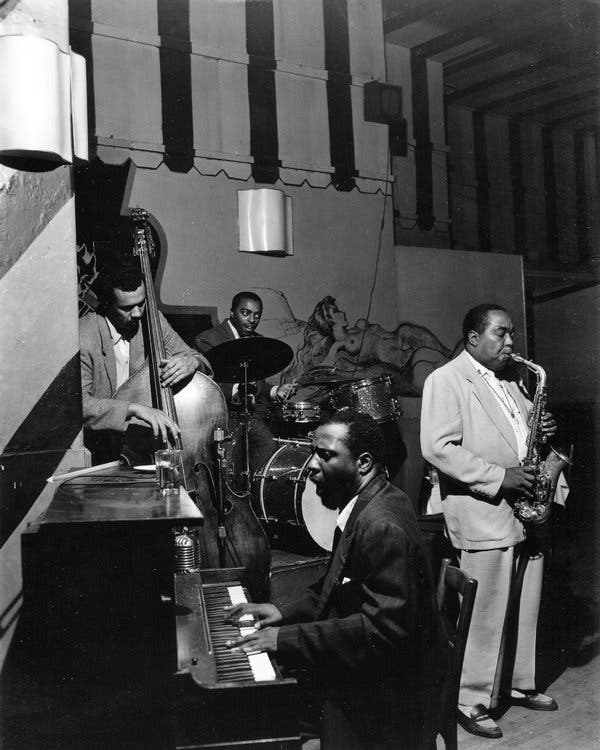
Monk, Mingus, Roy Haynes, and Bird
Bird called everyone B so he didn't have to remember names. On this occasion, the piano player they got for him (“they” being Robert Reisner, I believe) may have lacked playing experience but not pride. He said to Bird, “My name is Donald Cambrera – not B. Please call me Donald.” And, Bird did. He liked that.
On one occasion, a regular informal jam session night, my cousin James Lipton brought his new wife Nina Foch down to the Open Door, ostensibly to hear me play, if, indeed, I got a chance to play. Bill Heine was dashing in and out wearing a lady's blouse that may have been tie dyed. (Bill claimed to have invented tie dying.) Nina speculated that one of the regular drummers was an invert in the sense that Marcel Proust used the word. I said that there was no chance that he was, as I knew him principally as a drummer who played in the hard bop style we identify with Art Blakey. I (incorrectly) believed that this was inconsistent with anything but straight heterosexuality. But Nina insisted and we left it there. Many years later, I heard enough to change my mind; and, in the case of that drummer, I was not quite correct.
Among the visitors to the Open Door was Phil Woods who was leading a band in a club kitty-corner to the Open Door. Also, we saw a lot of Nick Stabulas, the drummer with Phil Woods, who much later played with Lennie and Warne at the Half Note. One LP record came out of Lennie's gig at the Half Note. Lately I have noticed one or two records with Jazz at the Open Door as part of their identification. One at least includes Charlie Parker. Here is a great picture from an impromptu session at the Open Door. has a few other photos and maybe the last thing I'll hear about The Open Door.
Eunmi Shim wants to know the same sorts of things that interest Ludovic
Brendan Godwin is correct as far as my knowledge of global warming and climate change is concerned. Although I completed 136 graduate credits at Courant Inst Math Sci with As principally in mathematical physics, I have not done anything in mathematical physics since Johnson bombed Cambodia in May, 1970. I got my PhD at U. of Utah solving large sparse sets of nonlinear equations associated with interlinked distillation problems by homotopy continuation. My thesis was awarded the Ted Peterson award for the best paper written by a student in computers and systems technology in 1987. I devised a row reduction algorithm that was faster than Gauss-Jordan and which would have been called the Gauss-Wayburn method if I had been as big a deal as Jordan. I discovered multiple solutions to distillation problems with homotopy continuation, which employs the LeRay-Schauder Theorem from differential topology. I gave up differential topology about 1990 after reviewing too many papers on homotopy continuation as part of the contemptible peer-review process. Since about 1990, I have restricted my scientific inquiries to what I call Net Energy Analysis, culminating in my present position on ResearchGate as the only human being who understands "sustainability". By way of apology for my “humility”, I wrote the following:
If I were the only human being who understood sustainability, how would I know it? Perhaps that statement was "a little bit outside," as Bob Uecker would put it. Nevertheless, I grow weary of explaining that: (1) it is better to define ERoEI so that 1.0 is precisely the dividing line between sustainable and not sustainable than to compute carefully an ERoEI that possibly exceeds 1.0 because you left out this or that while your colleague left out that or this and then assert without any computation at all that it will sustain the status quo if it is larger than 3, for example, where that 3 came off the top of someone's head (wow. that was a mouthful), (2) to achieve this precise identification of sustainability, one must count the energy budgets of all of the people who support the candidate technology, and (3) that, after stating the obvious conditions for sustainability, one is left with the harder problem of finding the ERoEI* of energy technologies and only that problem because energy is not just one thing, it is everything - if you will accept a figure of speech.
The whole point is not that you accept these things, which I spent a lot of time proving computationally using Excel, which I can't even afford to use anymore, but the people whom everyone accepts as the leaders of this field don't accept these truths as proven let alone as self-evident. And, what's worse, they don't even accept me. :-) But, don't worry, I won't let the world end if I can save it merely by swallowing my distaste for peer-reviewed publications. It may be that none of these establishment rags is willing to publish a proponent of wealth-sharing and an enemy of market economics and the money game.
People for whom this was written and Website
Eunmi Shim eshim@berklee.edu
Ludovic Ernault Ludovic Ernault ludovicernault@gmail.com
Charlotta Hayes Charlotta Hayes <charlotta.hayes@gmail.com>
Mark Linn <delmorerecordings@gmail.com>
Lennie Tristano Website
The people who were interested in Chet Baker
About the Author (from my main webpage at https://www.dematerialism.net/)
This website was designed, written, and constructed by me,
Thomas Wayburn of Houston, Texas. I am responsible for its contents. Please
address all correspondence to wayburn@dematerialism.net.
Corrections, suggestions, and constructive criticism will be appreciated.
Vituperation is acceptable too.
Born March 24, 1934, Detroit, Michigan. • Redford High
School Detroit 1951. • BS chemical engineering Michigan 1956. • MS
mathematics NYU 1968. • PhD chemical engineering Utah 1980. • Studied
jazz drumming with Lennie Tristano, Joe Morello, Philly Joe
Jones, Cozy Cole, Stanley Specter. • Here is an mp3 version of the
record I made with Lennie Tristano and Peter Ind when I was
22 years old. If you are interested, copy https://dematerialism.net/tristano.mp3 and paste into browser.
Hack engineering, chemical process design. • Teaching
chemical engineering at various levels: thermodynamics, plant design, applied
mathematics. • Writing and reviewing for the peer-reviewed scientific and
engineering literature, principally numerical analysis. • Software development,
computational chemical engineering. • Political activism, principally anti-war
and anti-growth, preaching limits to growth and advent of Peak Oil. •
Computational research in energy and economics. • Internet publishing: this website • Railroad modeling and
model railroad photography: https://modrr.net/.
View an earlier resume: https://www.dematerialism.net/Resume97.html
I am trying to complete a few of the projects I began many
years ago when I thought I would live forever. These projects are spread across
(i) science and the limitations it places upon rational political economy, (ii)
the great art of music - especially jazz music, and (iii) the world's greatest
hobby, namely, model railroading, whereby the strange, deadly beauty created as
a result of industrialization can be preserved in the only places where it can
do no additional harm, namely, museums - if we may include among museums the
private miniaturizations found in the homes of hobbyists.
A short interval of my life around 1960 is described in
“Jimmy and Me”, which enjoyed special editorial treatment without having to
submit to the phony peer-review system. (“Jimmy” was Jimmy Stevenson, an
aspiring bass player from Detroit, who was ready to play at any time.)
https://www.dematerialism.net/jimmy-and-me-by-tom-wayburn
A number of people who take a special interest in Chet Baker, an interest that I do not share, have asked me to tell the story of the short period in which the deservedly famous musicians Chet Baker and Philly Joe Jones lived with me in my distinguished apartment on East Twenty-First Street. I am putting this together bit by bit in https://www.dematerialism.net/mystory.htm
Tom Wayburn, drummer, vibraphonist, recording engineer;
computational chemical engineer, net energy analyst; political economist,
philosopher; model railroad planner, builder, photographer; computer builder,
programmer, operator, and technologist; document writer, essayist (That is,
from time to time I have been some of these things. I no longer have the
strength to keep up with much of anything. I shall be happy to edit my writing,
finish my model railroad, write up some of my experiences with music and
musicians, and edit a few dozen audio tapes. I have some interesting stories to
tell – at least I have been asked to tell them. Also, I still have a great deal
to say that I have not committed to paper – yet.