C:\users\waybu\douments\aaaaaindex.doc 1022
Dematerialism
Degrowth, Decentralization, Demarchy, Delegislation, Deschooling,
and Dechrematisticalism
The prevention of competition
for wealth and power is a necessary and sufficient condition for Universal Sustainable Happiness. Any method whatever for achieving this is dematerialism. Any society in which it is possible
for one person to compete for greater material wealth or a greater share in
posterity than others is doomed.
Can
Resource Dominance Be Eliminated?
The
Defects of Capitalism: My List
Social Media, Music, and Model Railroading
Our
crisis has a physical component and an imaginary component. The physical
component comes from limitations in the quantities of land, water, consumable
energy, and the environment itself. The ecological footprint of the human race
exceeds the carrying capacity of Earth. The imaginary component is instability
in the monetary system caused by excessive debt and excessive monetary
inequality. To ameliorate the physical crisis we must eliminate the imaginary
one. I do not mean that indebtedness, poverty, and wealth are imaginary; but,
rather, that we can eliminate all three with the application of our
imaginations without affecting the physical universe. Stabilizing our
population and reducing our ecological footprint will ultimately have a
desirable effect upon the universe.
Regardless
of what the people want, the owners of the country want to retain their
positions of power, privilege, and wealth. Naturally, they despise the idea of
government control of the economy and the means of production; however, when a
crisis arises that they cannot handle, they readily accede to crisis socialism
to save them. During World War II, without adopting socialism completely, they
allowed rationing, wage and price control, and management of vital industries
by government employees (albeit members of the traditional ruling class) even
if they were paid only one dollar per year.
To
respond appropriately to resource and environmental limits, we need to
establish crisis socialism. However, to eliminate debt, we need to repudiate
the US dollar; and, to eliminate inequality, we need to pay everyone the same
even if no work can be found for them to replace the inessential work from
which they were furloughed to reduce our consumption of fossil fuels and our
ecological footprint. After all, the requirement that every citizen does useful
work to get paid and the requirement that the pay should be commensurate with
the value of the work are completely imaginary. The idea that everyone should
be allowed to get as much money as he can is completely wrong.
But
crisis socialism is a long way from Dematerialism.
For example, most of us still think about money as the reward for contributing
something useful to our community. The amount of money we acquire is the score
in the game of life. Instead, we should think of money as a way to
measure our consumption of scarce natural capital, which we can do once again
with a rational monetary system based upon physical quantities
which we now have scientific ways to measure rather than letting markets set
prices. Belief in the “invisible hand” of the market is now quite generally
recognized as belief in magic and, as such, no better than belief in astrology.
We shall show that there is no way to justify anything but equality in
consumption. Suffice to say that without equality of shares of the
sustainable community dividend our goal to prevent anti-social behavior
engendered by competition for resources to enhance status would
fail. We would be back to the dog-eat-dog economy.
Dematerialism refers to any political economy in which, due to the structure
and arrangement of the institutions, it is not possible for any member of the
community to acquire more wealth or material resources than another. Resource
dominance hierarchies cannot arise. In fact, the individual's share in the net
production of the community is not in play. The term may be applied to the
belief in or dedication to such a political economy. The principal
justification for this work is that it corrects the problems with Marxism that
have contributed to previous attempts to replace Capitalism, which, as we shall
see, is intrinsically unsustainable.
Direct
Aristotelian democracy is the basis for the so-called Fractal Government
proposed here so as to ensure that all political power is retained by the
people. Since every citizen must be a member of a community council which
determines public policy, the village or neighborhood, the basic political
molecule, must be small enough to3 be effective.
Thus decentralization must be the ultimate goal regardless of how the present
system has to be accommodated. In particular, the largest identifiable
political unit should be the drainage region, i. e.,
the contiguous portion of the land that drains into common reservoirs without
any of the neighboring areas draining into it. This is the fundamental unit of
land in ecology. (Professor Jorge Gabitto, formerly
the chairman of the department of chemical engineering at Prairie View
University, pointed out that our maps are drawn in the most regrettable manner
from the viewpoint of ecology. Rivers make convenient borders for map makers
but not for ecologists.) The space between the basic molecules and the
governing body of the entire ecological region is the fractal-like structure
shown in Figure 2. Additional necessities for decentralization are well known.

Figure 1. Fractal
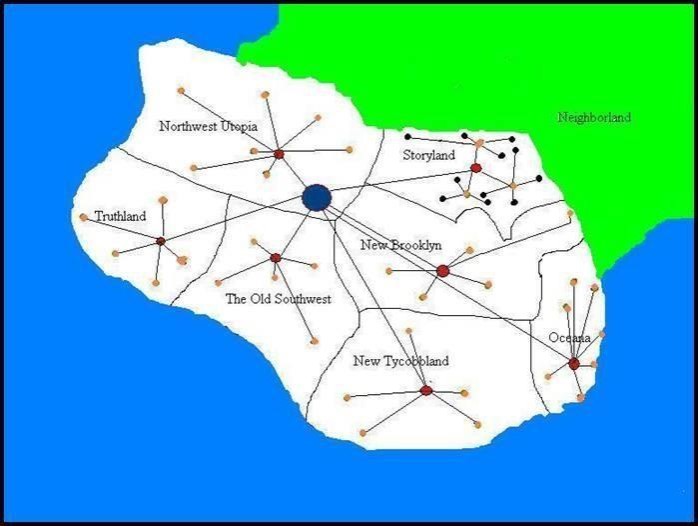
Figure 2. Fractal Political Structure
Demarchy is our name for a political economy in which distinguished
members of the government such as political representatives are chosen by sortition, the semi-random method we normally employ in
selecting jurors.
Our vast
systems of law are ridiculous. Laws should be replaced by a few simple moral
axioms from which right action can be derived easily. We should embrace
rational morals that anyone can follow as opposed to religious superstitions
and sexual and pharmacological prudery that no person of spirit can live by.
Dissent should be tolerated and even those who do not accept our rational
morality should be accorded the dignity of sovereign heads of state.
Our
system of morals should be derived from a complete, self-consistent, mutually
independent set of first principles that can be explained to a six-year-old and
upon which most educated people can agree. If, in addition, those who dissent –
even after we have employed our most compelling logical testimony – can be
accommodated without coercion and without inconvenience to themselves
or us, we shall have done very well indeed. – On the Preservation of
Species
Laws and
morals should be congruent. Behavior that the community finds immoral, can be legal only in an incomplete legal system;
whereas, a legal system that prohibits moral acts is tyrannous. Both laws and
morals are obtained for the convenience of the community, provided the
requirements of sustainability are met. There are certain aesthetic and other
intuitive principles that we hope will come into play. I shall attempt to
justify my otherwise arbitrary choices in the section on axiomatic morality
below.
It makes
sense to enter into the record at this point Professor Al Bartlett's famous
talk, which explains how man's ignorance of the exponential function has
affected our present population crisis: https://eroei.net/bartlettexp.mp4
As Prof.
Bartlett puts it:
Can you
think of any problem in any area of human endeavor on any scale, from
microscopic to global, whose long-term solution is in any demonstrable way
aided, assisted, or advanced by further increases in population, locally,
nationally, or globally? - A.A. Bartlett, January 8, 1996
I can
think of no better tribute to Al Bartlett than to emulate his challenge:
Can you think of any social problem on any scale that is not exacerbated by the
institution of private profit? In particular, I claim that population increase
is worsened by the institution of private profit. The problem of
over-population will not be solved except by Die-Off in a society that permits
private profit.
If I may
be permitted to widen the meaning of the term private profit to include (i) the increase of the proportion in the population of ones
race, religion, politics, culture, or point of view and (ii) the increase in
ones own or ones employer's, relative's, colleague's, or ally's accumulation or
share of material wealth, then my challenge to the world is to name a single
problem of humanity that is not exacerbated by private profit. It is the
term "material" in "material wealth" that supplies the term
"material" in the word "dematerialism".
Here are .wmv and .mp4 versions of Albert Bartlett's
famous talk on the exponential function as it applies to population:
http://eroei.net/bartlettexp.mp4
http://eroei.net/bartlettexp.wmv
It takes
about 10 kilocalories of primary energy to supply one kilocalorie in our diets.
Just now, we have enough conventional and fracked oil
to support an agriculture sector that can support a large over-population;
however, there are compelling reasons to abandon fossil fuel chief among which
are the alarmingly high probability of catastrophic climate change and the
absolute certainty that the supply of fossil fuel is finite and eventually will
cost more energy to harvest than it will return. Perhaps it is not too soon to
state a fundamental principle of social planning and forecasting, namely, that
any event in the future of society that should be expected soon because of the
nature of the exponential function should be treated as though it will occur
tomorrow.
I tried very hard to prove that
capitalism requires economic growth and ended up with nothing better than a
reasonable plausibility argument.
David Delaney, however, provided a completely satisfying explanation in “The Economic Growth Trap” which became the first
step in the physical argument for Dematerialism.
“The Economic Growth Trap” by
(the late) David Delaney. Today (01.23.06) I read “What to
do in a failing civilization” by David M. Delaney. It contained the best
explanation of why American-style capitalism requires growth I have ever
seen. With the kind permission of the author, it is reprinted
below. David posted the full paper and his other essays at http://geocities.com/davidmdelaney/.
David Delaney died a few years back; and, I no longer know
where to find his excellent work. Someone should do whatever it takes to find
this storehouse of well-considered thought.
Economic
growth requires increasing the amount of high quality energy and materials degraded
by the economy each year. Economic growth on a finite planet will
eventually stop. If it does not exhaust the resources needed for its
continuation, it will stop earlier for some other reason. Allowing
resource depletion and biosphere degradation to terminate economic growth will
produce catastrophe. Unfortunately, our dependence on economic growth
makes it extremely unlikely that we will give it up voluntarily before the
catastrophe. Our dependence has at least four aspects: A) in the need to
deal with adverse consequences of labor-reducing innovations, B) in commercial
bank money, C) in the need to maintain tolerance of inequality, and D) in
financial markets.
A) The
first dependence on economic growth is in the need to avoid the adverse consequences
of innovations that reduce the need for labor.1 By
definition, each labor-reducing innovation either increases the amount of a
good produced or throws some people out of work. Firms that create or
exploit a labor-reducing innovation create new jobs internally by driving other
firms out of business. The new jobs implementing the innovation offset
the loss of jobs caused by the innovation, but the innovating firms don’t
necessarily hire all of the job losers, because the innovation reduced the total
amount of labor needed to produce the original amount of the good. In
order to re-employ all job losers, the economy must grow to produce more of the
good with all of the original workers, or produce more of some other good with
the cheaper labor (the job losers) now available. In either case the economy
grows. Much of what we consider progress is due to labor-reducing
innovations. In order to live without economic growth, we would have to
give up this kind of progress, or introduce arrangements to allow workers who
become unproductive to retain their relative wealth and self-respect, or
relegate most people to a repressed underclass. There is a powerful
incentive to avoid these contingencies by encouraging economic growth.
B) The
second dependence on economic growth is in the creation of money by the act of
borrowing at interest from commercial banks. Much of the money in each
loan by a commercial bank is created by the loan itself. The bank
collects a fee—the interest—for providing the service of creating the
money. Other ways of creating money have been explored in theory and
practice. Successful local currencies have been based on some of these
alternatives, (see Douthwaite, Short Circuit, page
61) but all national money is now created by interest-bearing loans from
commercial banks. This way of creating money contributes instability to
an economy based on it. In order to keep the money supply from
contracting when a loan and its interest are paid, a larger total of new loans
must be created, increasing the money supply. (This is not transparently
obvious. For a more detailed explanation, see Douthwaite,
The Ecology of Money, page 24.) When the economy grows to match the
increasing money supply, the value of money is relatively stable, and commercial-bank-created
money is benign. If the rate of economic growth does not match the rate
of growth of the money supply, the money supply becomes unstable. Given
the use of money created by interest-bearing loans from commercial banks, an
economy can minimize the resulting instabilities of the money supply by
sustaining moderate growth. Monetary instability would put significant
hazards in the way of deliberate attempts to contract our economy unless the
creation of money was radically reformed.
C) The third
dependence on economic growth is in the political and geopolitical need for
tolerance of inequality. Differences of wealth are at least as great
within the developed countries as they are between developed and developing
countries. Think of the ratio of the average income of American CEOs to
the average salary of workers in their companies. Domestically and
internationally, the tolerance of the poor and middle classes for the existence
of wealthier classes and countries depends on a belief in economic
growth. The poor struggle, while seeing that others are wealthy and still
others are grotesquely wealthy. The poor are told a story: if they
keep to their work and to their diversions, and tolerate the rich, they will be
better off in the future than they are today. They believe this story, or
at least don’t revolt against it, because it is supported by propaganda and
shared myths, and has been true for many. When economic growth disappears
forever, the poor, like everyone else, will recognize that they will be
progressively worse off, with no future relief possible. The peaceful
tolerance by the poor and the middles for the rich will disappear. A
peaceful end of economic growth would require redistribution of wealth, with
consequent political and geopolitical contention. Desire to avoid the
contention makes it unlikely that deliberate elimination of economic growth
will be attempted before economic growth is ended by nature. The
intolerance of differences of wealth that will then appear will itself not be
tolerated by the rich, causing additional domestic and international conflict
just at the advent of other adverse changes. At that time, if not before,
tyrannical repression of the poor will greatly tempt the rich.
D) The
fourth dependence on economic growth is in the financial markets—the mechanism
of capitalization of public corporations. Public corporations, the main
actors in industrial economies, depend on financial markets not only for
capital for innovation, but for discipline, valuation, motivation, and a major
part of their rationale for existence. Owners of capital—investors—give
the use of it over to public corporations by buying equity or debt in financial
markets. They do so only because they expect that they will, on average,
and over the long term, receive back more than they gave up. That
expectation disappears when most investors understand there will be no economic
growth. Most of the apparent wealth of the world consists of equity and
debt bought and sold in financial markets. Any realistic possibility of
the end of growth would fill investors with something like terror.
Political initiatives to bring an end to growth will be opposed by
investors with every means at their command. The controversial nature
of proposals that would reduce or eliminate economic growth will likely prevent
the proposals from reaching even the status of political contention. When
the onset of sustained economic contraction is generally perceived, investors
will withdraw from financial markets. The resulting failure of the
markets will make many necessary developments impossible to finance and will
produce confusion and stasis in public corporations just when we need them to
adapt to new circumstances.
[end of Economic Growth Trap]
We may
assume that, after all reasonably anticipated energy conservation technology
has been developed and installed, economic growth must be accompanied by growth
in energy consumption, which must result in the rapid onset of Peak Oil in the
sense of Hubbert and, subsequently - if permitted,
exponential growth in the number of nuclear installations. We must assume that,
without fusion, some sort of breeder reactor will replace fission. Even if we
neglect global warming and the China Syndrome, we must
give up NIMBY, since continued economic growth will place nuclear plants in our
backyards.
It may take only a few minutes to read the hyperlinked material; but, it took
weeks to write it after reading the University of Chicago's and MIT's reports
on the future of nuclear. See The Nuclear Option https://dematerialism.net/NuxlearOption.html from
“On the
Conservation-within-Capitalism Scenario”:
In other
words, suppose we can visualize a world in which economic growth is tolerated
into the indefinite future. After every reasonable conservation measure has
been taken by a non-increasing population, every new quantum of economic growth
will result in a corresponding increase in our total consumption of emergy –
not by a constant factor regardless of other considerations, but by some
factor, φ, greater than 1.0. (Actually, φ > 1 + ϵ, where
ϵ is a constant greater than zero; i. e.,
φ is not constant, but ϵ is.) Thus,
continued economic growth must be met with a corresponding greater capacity to
produce energy. Given the limitations on fossil fuel production, we must choose
an energy production technology capable of sustaining perpetual growth. This is
impossible as amply demonstrated in the case of nuclear energy, which might be
the best choice for the attempt. See “The Nuclear
Option”, taken from “On the Conservation-within-Capitalism Scenario”,
where the finite size of the Earth is the limitation. Although we know of no
exception to this rule, we would still like to have a mathematical proof.
When I embarked upon this project, it seemed obvious that
we would have to abandon fossil fuels in favor of renewable energy, provided
renewable energy technologies with EroEI* (“ER over
EI star”) no less than 1.0 could be found or developed. One had the scientific
consensus regarding Anthropogenic Global Warming, which had no more than a 49%
(for the sake of argument) chance of being wrong, if we neglect predictions as
to just when certain temperature signposts would be reached. We may assume that
such signposts that the theory predicts will be reached eventually should be
treated as though they required immediate action, just as we assume every gun
is loaded. In addition, we had the finite supply of oil, the consumption of
which was increasing exponentially, which according to similar reasoning,
should be viewed as essentially unavailable.
One wonders, then, if the maximum possible energy production from renewable
energy equals or exceeds the total energy budget for the entire nation.
Incidentally, I found it necessary to validate the technique whereby the energy
cost of a high-dollar project well-distributed over the sectors of the economy
was found by multiplying the E/GDP ratio by the gross cash investment for the
project under consideration. This assumption was corroborated by the analysis
of “Energy in a Mark-II-Economy”. Finally, “Energy in a Natural Economy” uses
Bureau of Economic Analysis data to determine how much useful work will need to
be performed per unit of time after we power down to the Earth as a Garden.
Finally, the paper “On the Conservation-within-Capitalism Scenario”
indicates that renewable energy technology is inadequate to support
American-style Capitalism. However, examples of sustainable political economies
are given.
What is to be done with that section of the possessors of
specific talents whose talent is for moneymaking? History and daily experience
teach us that if the world does not devise some plan of ruling them, they will
rule the world. Now it is not desirable that they should rule the world; for
the secret of moneymaking is to care for nothing else and to work at nothing
else; and as the world’s welfare depends on operations by which no individual
can make money, whilst its ruin ... is enormously profitable to moneymakers,
the supremacy of the moneymaker is the destruction of the State. A society
which depends on the incentive of private profit is doomed.–
George Bernard Shaw, The Millionairess.
Here is
a case in which we can do no better than to quote the Wikipedia, which is
permissible under the applicable rules:
“Aristotle established a difference between
economics and chrematistics that would be foundational in medieval thought. For
Aristotle, the accumulation of money itself is an
unnatural activity that dehumanizes those who practice it. Trade Exchanges, money for goods, and usury create
money from money, but do not produce useful goods. Hence, Aristotle, like Plato,
condemns these actions from the standpoint of their philosophical ethics. [snip]”
Thus, activities
that are performed to obtain a greater share of the net proceeds of the economy
for the worker or his employer but produce nothing that we need to live and
enjoy life can be distinguished from genuine economic activity by the term
“chrematistics”. Inasmuch as this constitutes a huge overhead on the economy
that we can no longer afford as we approach Peak Oil, we take the liberty of
referring to the elimination of chrematistics as dechrematisticalism,
partly for the pleasure of coining a beautiful large word but mostly because it
will postpone the extinction of the human race for an astronomical period of
time. This analysis was verified in “Energy in a
Natural Economy”. Notice that I had a good notion of the split
between economics, in the sense of Aristotle, and chrematistics, even though I
did not know the word. Notice, as well, that the sort of people who would own
the world, as in the game of monopoly, which likewise is played in a world that
cannot grow, would be stripped of their peculiar power; and, the introduction
of a new monetary system (acually a system of
rationing consumption) would prevent the sort of inequalities that precede
violent revolutions.
Can
Resource Dominance Be Eliminated?
It will, of course, be said that such a scheme as is set
forth here is quite impractical, and goes against human nature. This is
perfectly true. It is impractical, and it goes against human nature.
This is why it is worth carrying out, and that is why one proposes it.
For what is a practical scheme? A practical scheme is either a
scheme that is already in existence, or a scheme that could be carried out
under existing conditions. But it is exactly the existing conditions that one
objects to; and any scheme that could accept these conditions is wrong and
foolish. The conditions will be done away with, and human nature will
change. The only thing that one really knows about human nature is that
it changes. Change is the one quality we can predicate of it. The
systems that fail are those that rely on the permanency of human nature, and
not on its growth and development. — Oscar Wilde, The
Soul of Man Under Socialism
Let us
set aside, for a moment, the possibility of a benevolent deity the existence of
whom would assure any reasonable person that resource dominance has no
permanent place in human nature (theism); or, what amounts to the same thing,
that the true nature of Man is inherently noble (humanism), so that resource
dominance is merely an example of a temporary corrupting influence that will
soon be corrected. We are left with little more than the choice between
Transcendental Idealism represented by the Copenhagen interpretation of quantum
mechanics and Transcendental Realism represented by the global-hidden-variables
interpretation of the Einstein-Podolsky-Rosen gedankenexperiment as actualized by the experiments of
Alain Aspect and his co-workers. In case of theism, humanism, or
Transcendental Idealism, resource dominance can be eliminated from human
behavior by eliminating the corrupting influence, namely, materialism, or by
the timely intervention of good fortune.
In the
case of Transcendental Realism, we may retain hope for Dematerialism
in all but the last of the following cases:
1.
Resource dominance is not an intrinsic characteristic of human nature.
2.
Resource dominance is an intrinsic characteristic of human nature; however, it
can be subverted by re-directing it toward more realistic ways to achieve
reproductive advantage (i) by manifesting excellence
in all of our activities so as to earn the admiration of members of both
genders or (ii) by manifesting greater sex appeal than other candidates for the
affections of members of the opposite sex. This redirection can be
achieved by education, indoctrination, legislation, or any combination of
these.
3. Our
knowledge of human nature is insufficient to make a judgment either way.
4.
Finally, it is possible that resource dominance is an intrinsic characteristic
of human nature that cannot be subverted – even by law backed by certain and
severe punishment, in which case Dematerialism is
impossible.
For this
important subject, which, perhaps, is the sine-qua-non of the trip to dematerialism for the majority of people, I shall have to
rely principally on the work of others, as I have done practically nothing
myself except to add five points to John Gatto's
famous list and to say what must be said in the argument for the legalization
of drugs.
Why K–12
Education Does More Harm than Good
Graduate
education in engineering and science
Character
Education, Anti-Drug Propaganda, and Religion
The Scapegoating of Drugs and Mass Hysteria
John Gatto’s Seven-Lesson School Teacher
The Role of
Materialism in the Mis-education of Youth
https://www.dematerialism.net/sustainability.htm
The Defects of
Capitalism: My List
17) Nearly
everyone worries about money. The majority of marital disputes are about
money.
24) Nations
seeking new markets adopt imperialistic foreign policies that lead to terrorism
and war. Actually, foreign trade has become war.
34)
Materialism makes possible the bidding up of junk to the status of art.
Dematerialism Satisfies
Moral Requirements and Is Sustainable
ERoEI*, Energy
Returned over Energy Invested, is the Measure of
Sustainability.
Solve population problem. Population de-growth is most important.
Economic de-growth is necessary too as follows:
Close stock markets, which will have become zero-sum games at best.
Ban fractional reserve banking.
Prevent pollution. Prevent waste, including waste of
talent and beauty. Prevent wage slavery.
Establish true renewable energy technology.
Devise methods to achieve the aforementioned.
There is nothing either good or bad, but thinking makes it so. –
Shakespeare's Hamlet
Nietzsche came to this sentiment rather late in the day
and Mary Baker Eddy gave it second place on her Frontispiece in Science
and Health; but, the authorities are not needed, as one can verify the
truth of it with a little reflection.
We Need a New Monetary System: The complete essay as far as
I got
On the
Conservation-within-Capitalism Scenario [Preliminary Version 1.2]
Energy Returned over Energy
Invested
ERoEI* as a Measure of Feasibility
David Delaney's paper "The Economic Growth Trap"
The Demise of Business as Usual
https://www.dematerialism.net/ops.htm
Other material sent to Researchgate that I should
keep my eye on.
On the Preservation of Species (full 600-page book in one file)
On the Preservation of Species (table of contents hyperlinked to
individual chapter files)
Social Problems and Solutions (many important ideas from the book – 56 pages)
Useful Concepts from On
the Preservation of Species
Emergy (from
Chapter 2 of On the Preservation of Species)
On Emergy (from “Energy in a Mark II Economy”)
Availability Balance on Earth Redux
Emergy and Population in a Natural Economy
Thermodynamics, Availability, and Emergy
On the Conservation-within-Capitalism Scenario
The Demise of Business as Usual
EROI* as a Measure of Feasibility
EROEI as a Measure of Feasibility
Energy in a Natural Economy (8by9w)
A Report on
My Recent Investigations of Solar Energy Harvested by Photosynthesis in a
Controlled Environment
The Feasibility of a
600 Kilowatt Windpower Installation
Letter to John Kaminsky concerning Peak Abiotic Oil
Psychology as a Tool
of Political Repression
Communism and
Some Idle Thoughts on the Excesses of Capitalism
Computing Crude Birth Rates from Total Fertility Rate
On Designing a Community Currency
Talk to be
given at Schreiner College on Washington ’s Birthday
On “Entrepreneurship and Social Progress” by Lew Rockwell
Is There a
Conflict between Property Rights and the Moral Requirement to Protect
Endangered Species?
On Socialism, Utopian and Scientific by Frederick Engels
On William Buckley’s ‘Agenda for
the Nineties’
American Myths and Higher Education
Some Unintended Effects of
Computers
A Brief Outline of the Harm Done by Improper Religions
On the Separation of Church and State and the Case Against Christianity and Other Improper Religions
On the United Nations Universal
Declaration of Human Rights
How to Find the Day of the Week in
Any Year
Expected Value of a Texas State Lottery Ticket
This essay
belongs to an earlier period when the number of numbers from which to choose 6
was 50. However, it illustrates the essential dishonesty of the Great
State of Texas rather nicely. Amusingly, when they added three more
numbers, thus reducing the probability of winning drastically, they advertised
“Now, with three more numbers to choose from”, as though three more numbers for
the same price made it more of a bargain, which some users probably thought to
be the case. On the other hand, a large number of players have been
choosing 1-2-3-4-5-6 because they think no one else with whom they would have
to share their prize will choose it. They know that this sequence is just
as likely to come up as any other sequence, which shows that some players may
be more numerate than we had previously guessed.
Letter to Time Magazine in A Concise Introduction to Logic - Page 12 - Google Books
The Case for Drug Legalization and
Decontrol in the United States
Fallacies and Unstated Assumptions
in Prevention and Treatment
A Review of the 1990 Drug Policy
Foundation Conference
A Seven-Point Post-Prohibition
Policy
Can the State Teach
that Drugs are Wrong and Harmful?
Despite Recent Flurry of Anti-Drug Propaganda, Drug
Prohibition is Indefensible
Two Crucial Issues in the Argument
for Drug Legalization
Social Media, Music, and Model
Railroading
Facebook: https://www.facebook.com/twayburn/
Twitter:
https://twitter.com/ThomasLWayburn
Reddit:
https://www.reddit.com/
Linked In:
https://www.linkedin.com/
https://dematerialism.net/jazzandclassical.htm
https://slimwiki.com/wayburn/jazzandclassical
https://slimwiki.com/wayburn/modrr
Energy and Population Hyperlinks
Open People, Open Source, and
Public Domain Hyperlinks
View an earlier resume: https://www.dematerialism.net/Resume97.html
A number
of people who take a special interest in Chet Baker have asked me to tell the
story of the short period in which the deservedly famous musicians Chet Baker
and Philly Joe Jones lived with me in my distinguished apartment on East
Twenty-First Street. I am putting this together bit by bit in https://www.dematerialism.net/mystory.htm